Tuesday, August 1, 2023

Drainage... Drainage... Drainage!

While attending The Pennsylvania State University in 1991, my mentor and famed turfgrass scientist, Dr. Joe Duich asked my fellow students and I, “What is the most fundamental aspect of successful turfgrass management?”  Dr. Duich, known for his wit and challenging teaching style had many leery to respond. After a few failed attempts by my classmates to answer his question, Dr. Duich responded, “It’s not rocket science, if you want to be successful at growing turfgrass, you need drainage... drainage... drainage!" He continued, "Surface drainage, air drainage and subsurface drainage are all critical" 


Once a golf course is constructed and open for play, surface drainage can be increased by adding catch basins and piping to a water body or slope can be modified through a renovation. Air drainage can be enhanced through underbrush or tree removal (or fans), but are not an option for everyone. However, subsurface drainage is an annual process on almost all golf courses. Subsurface drainage is partially managed through aerification and topdressing, which we do a significant amount of at Olde Florida. However, it can be impacted more significantly through the installation of subsurface drainage.   


This summer my staff installed 1,700 linear feet (1/3 of a mile) of subsurface drainage. This brings the total subsurface drainage, or what some refer to as a "French drain" that my teams have installed in my 31 years as the golf course superintendent at Olde Florida to over 16 miles.  


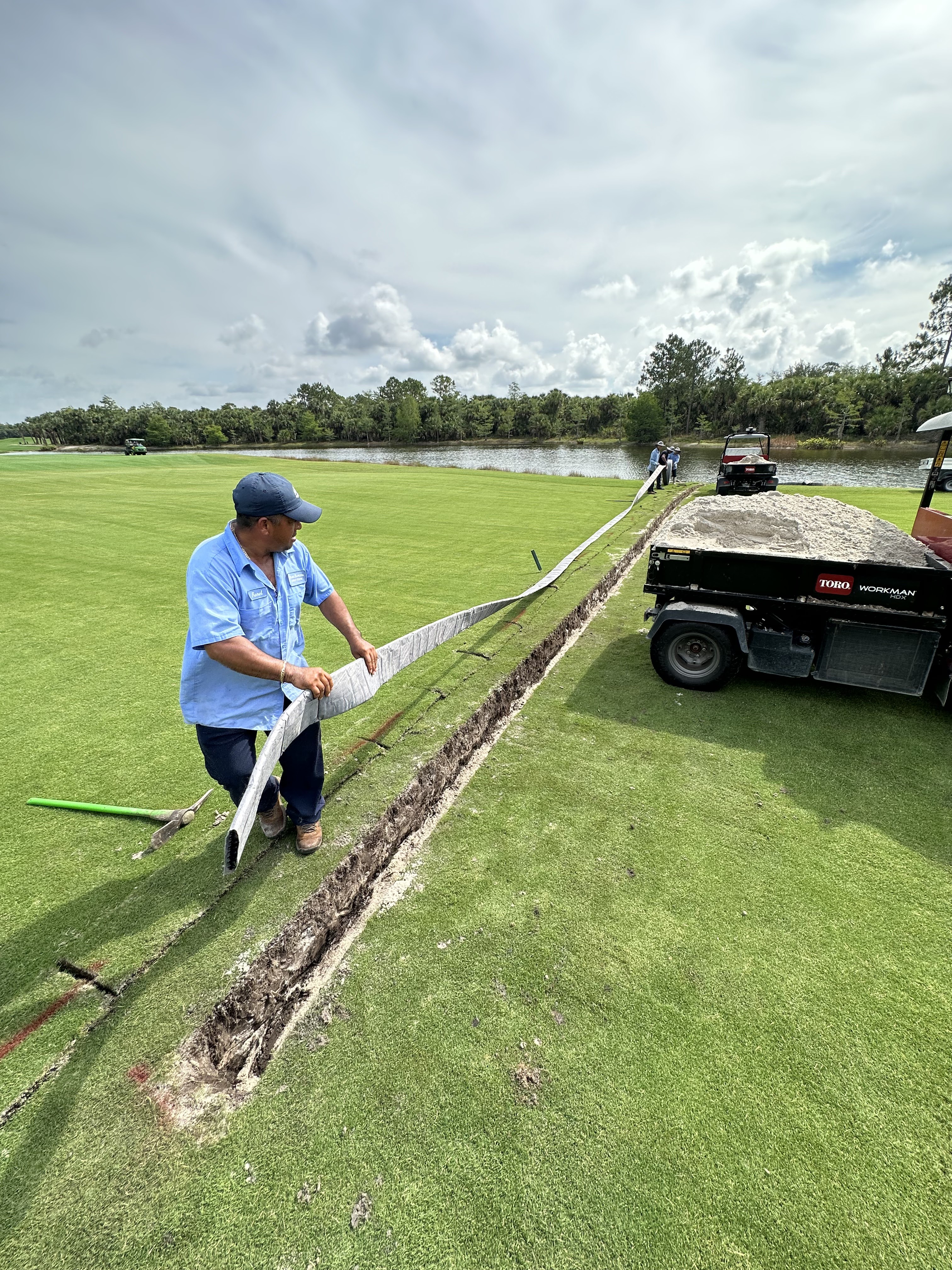
The steps in our drainage installation at Olde Florida are fairly simple. First we analyze the area and figure out the best method to get water from “point A to point B”. Once analyzed and determined I paint the drainage project on the turf with a paint gun (the easy part). My assistants then consult our irrigation as-built, a wire tracer, etc., to determine if there are any subsurface items that the staff will need to avoid. Next, a sod cutter with a 12-inch blade is used to remove the turfgrass, and then the hard part begins, the excavation of the soil (and often rock) to a depth of 18 inches and a width of 12 inches. Finally flexible drainage pipe is laid in the bottom and center of the trench, coarse sand (gravel in the past) is carefully installed, compacted and then the sod (with minimal thatch) is re-installed. 


Trench Excavation 

TurfDrain Rolled Out 


TurfDrain Ready for Installation 

Sand Being Added to Trench


TurfDrain / Sand Installation 

Sod Re-installation


Often when installing drainage we discover existing drainage that was installed at some point over the last 31 years. While still effective in receiving subsurface water moving laterally in the soil, many have lost effectiveness of moving water downward from the surface into the drainage system due to natural buildup of thatch/organic material. 

Existing Drainage (Old) with 6" of Organic Matter Above  

Existing Drainage (Old) 8" Below Surface


This summer drainage projects included an area in front of #2 approach, in the swell to the left of #3 green, an area at the front right-side of #6 fairway, the chipping area to the right of #6 green, four separate projects on #16 fairway and two projects on the east chipping green.  


Hole #2

Hole 2 


Hole #3 


Hole #6 


#16 Fairway

More information on the TurfDrain product can be found here.


Tuesday, July 4, 2023

“Why do you aerify greens when they are in great condition?”

A common question in the golf industry is, “Why do you aerify greens when they are in great condition?”  The quick answer is that weather plays a large role in recovery. Therefore, performing aeration when the weather favors turf growth leads to quicker recovery. Aeration is also stressful on turf so performing the task when the turf is in "great" condition is also vital. 

Practice Green 7/4/23 - 7 Days after Aerification 

We are fortunate in Southwest Florida this coincides with the time of year the majority of the membership has left for the summer. At Olde Florida we perform various types of aeration throughout the summer; however, we are most aggressive in the early to mid-summer. One reason is the days are the longest. The summer solstice (longest day of the year) was June 21. 

We also want to perform aggressive aerification earlier in the summer to avoid cloudy, rainy days. Weather is obviously unpredictable, but in general as summer in Southwest Florida progresses, we see an increase in cloudy weather. Clouds and rain reduce sunlight, and sunlight is essential to warm season turfgrass recovery. Historically we also have a greater likelihood of severe weather from tropical systems or hurricanes as the summer progresses. The negative impacts from severe storms could delay or cancel scheduled procedures, or at a minimum slow the turf recovery. 

Topdressing - Practice Green 6/26/23

Core Aeration - Practice Green 6/26/23

Another question that is sometimes asked in the golf industry is simply, “WHY do you aerate?”  At its most basic, aeration helps keep soil "healthy" and healthy soil plays a significant role in healthy turfgrass. 
Agronomy textbooks teach that “healthy soil” consists of:
  • 45% solids 
  • 25% air 
  • 25% water 
  • 5% organic material 
"Healthy Soil" - Practice Green 

In more detail, when done in conjunction with sand topdressing core aeration: 
  • Reduces compaction 
  • Dilutes organic matter 
  • Improves infiltration 
  • Increases oxygen exchange 
  • Reduces dry spots 
It’s also important to vary the depths of aerification practices to prevent the development of compacted layers in the soil profile. At Olde Florida we utilize two processes to achieve this, the Drill and Fill and the DryJect aerification methods. Both have advantages, and most years we will contract one of each. 

With the Drill and Fill soil is brought to the surface and the holes are filled with kiln dried sand. The diameter and length of the bits are customized to each property At Olde Florida we utilize a 1" bit, set to a depth of 10”. The top 7-8” of our greens profile is the zone that we have organic buildup from 31 years of growth. 

Drill and Fill - Practice Green 5/30/23


Drill and Fill (video) - Practice Green 5/30/23
  
The Dryject has a quicker recovery time than the Drill and Fill, but the depth can be variable depending on soil conditions. Also, no organic material is removed with the DryJect. At the end of summer, after numerous cultivations we can achieve a sand depth of approximately 7” with the DryJect Maximus process. 

DryJect - Practice Green 10/4/22


DryJect (video) - Practice Green 10/4/22
 
Our goal has been, and will always remain to perform the more aggressive cultural practices during one of the five, week-long closures to reduce the impact to our summer players. 

When conditions do not favor quick recovery we also utilize several less aggressive aeration processes. These include; "Ninja tine," "needle tine," and water injection aeration. The Ninja tine is fairly new to the industry, but it's gaining popularity due its ability to pull a consistent small core; consequently, removing organic matter with minimal disruption. The needle tine and water injection aeration methods do not "pull a core" so no organic material is removed. These practices have no impact on the surface and most players never know the procedure has been performed.


The Hydroject - 8 Green 2/23/23


Monday, June 5, 2023

Summer Update

Over the course of every summer Olde Florida closes for five weeks so the agronomy team can perform necessary, aggressive cultural practices. The cultural practices, which include aerification, vertical mowing and topdressing are vital to help insure the turfgrass remains healthy and the golf course is in the best possible playing condition for years to come. The first closure of the 2023 summer began the day after Memorial Day and it was a WET, but ultimately productive week! 

The weather in SW Florida in the summer can be unpredictable! We are hopeful that Mother Nature will cooperate with us on our closed weeks, but last week she did not! In the first five months of the year we only had 6" of rain at Olde Florida. Thanks to Tropical Storm Arlene, last week we matched our year to date 6" with an additional 6" of rain! The rain caused several delays, but ultimately we were able to complete our desired tasks. 

The primary goals for the week were to perform a "double" Drill and Fill on the greens, a fairway topdressing and a "wall to wall" Chipco Choice application. 

This is the fourth consecutive year we have performed the Drill and Fill process on the putting surfaces. Even with frequent traditional core aeration, vertical mowing and sand topdressing, organic matter accumulates. Consequently, to extend the performance of mature greens, traditional thatch control methods can be supplemented with soil modification techniques that deposit sand completely through organic matter accumulation. One of these processes is the Drill and Fill. Click here to read a detailed report on extending the life of mature greens.

Drill and Fill, Practice Green

Drill and Fill increases soil porosity and drainage significantly more than traditional aeration due to the significant amount of sand that is delivered much deeper into the soil. When the drill bits are inserted and lifted from the subsurface, organic matter is removed from the profile leaving channels that are backfilled with dried, bagged sand. 

Last week at Olde Florida 1” drill bits were utilized to penetrate the surface of the greens to a 10” depth. The holes, which are spaced approximately 3.5" by 7" apart were then immediately filled by the machine with a total of 168 tons (336,000 pounds) of the bagged dry sand. 

Below are videos of the Drill and Fill being performed on the practice green at Olde Florida. 


Another of the primary goals for the week was topdressing all 22 acres of fairways (this included the 1 acre short-game practice fairway). 1,100 tons (2,200,000 pounds) of sand was applied by a contractor to a depth of approximately 1/3". Because of the volume the clubhouse parking lot was utilized to stage the sand. 

Clubhouse Parking Lot

Topdressing 1 fairway 


11 Fairway After Topdressing 

This is a video of the contractor topdressing 11 fairway. 


Last week Chipco Choice was also applied to the 104 acres of tees, fairways, approaches and rough on the golf course. Chipco Choice is an insecticide that is used to control mole crickets. The product is a very safe, target specific insecticide that is applied at an extremely low rate. It's slit directly into the soil/thatch by licensed contractors with certified application rigs. The product has a long soil residual that withstands the frequent rainfall in the Southeast.  

Mole crickets are a very serious pest that left untreated can do major damage to turfgrass. The insect tunnels through the soil, often close to the surface, severing grass roots and causing the earth to bulge upwards. They also eat the roots and shoots of plants where they are tunneling. Mole crickets are active year-round in Florida, but do the most damage during spring (March through June) or fall (late August to early October) when they are mostly adults.

In addition to the Drill and Fill and fairway topdressing, all of the tees, approaches and chipping areas were topdressed by Olde Florida employees. 

Note: In the picture below you can see the slits in the turfgrass where the Chipco Choice was cut into the surface.   

Topdressing 13 Tee


Monday, May 15, 2023

Annual Report to the Olde Florida Golf Club Membership

Vanderbilt Beach Road Extension Update 

The Vanderbilt Beach Road Extension project is an approximately 7-mile extension of the existing six lane road.  The extension will begin to the west at Collier Boulevard and it will end to the east at 16th ST NE. The county reports the project will take approximately three years to complete. The project began in the fall of 2022.  

What we will see over the next 6-months is more of we are currently experiencing. Clearing and organic debris removal will continue, but there should be no more burning. The contractor will also continue to dig the new Big Cypress Canal. It’s a slow process since the county is not allowing any blasting to breakup the subsurface limestone. 

The original plan was to start road construction (paving) on the west end at Collier Boulevard. The section between Collier Boulevard and our southeastern property line (8 tee) is the most complicated section. For one reason the contractor will have to connect all existing drainage that currently exists into the existing Big Cypress Canal into the new canal. This has to take place prior to filling in the existing canal.

Due to some challenges (environmental and the complexity of the construction at the west end) the county and contractor made the decision to start road construction at the east end. What that means for us is we won’t see the existing canal filled in until next winter. Beginning around January of 2024. 

We will probably see some road construction at the end of 2024. So the next winter golf season (2023/2024) will be similar to this one. The following season (2024/2025) paving at our end will be occurring and if they stay on schedule the project should be complete in the fall 2025 (the start of the 2025/2026) season. Unfortunately the 8’ chain link fence and plantings on our southern property line will not be complete until the end of the project.  

Golf Course Update 

We had another warm winter, due in part to the La NiƱa weather pattern that has been in place over the last three seasons. Numerous heat records were set this winter. The weather was great for turfgrass growth and recovery, with the only challenge being green speed. With growth regulation and other processes we have provided very good green speed. We check soil moisture with a digital sensor and green speed on two greens daily. The average green speed since January 1 has been 11”6”

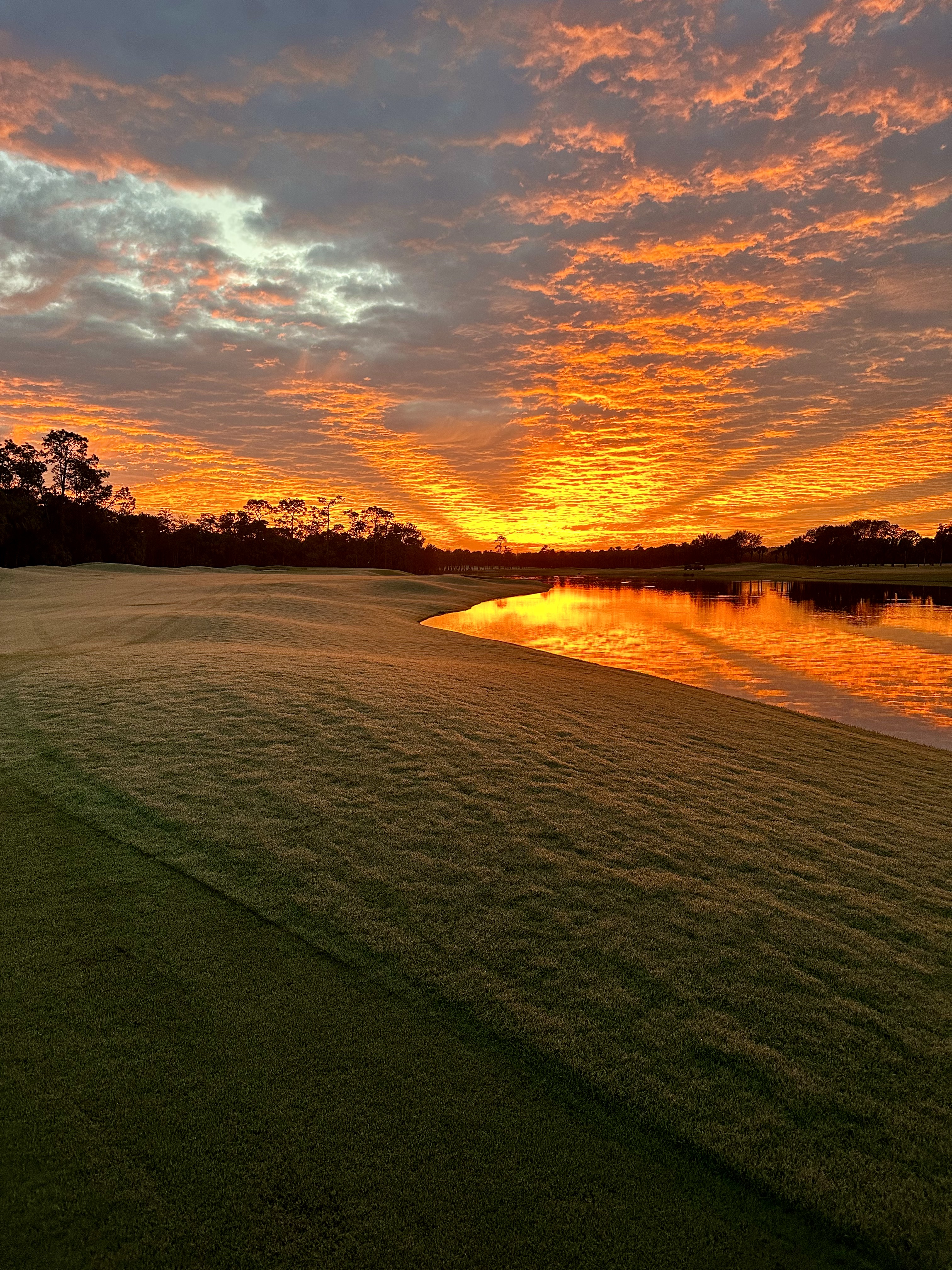
Sunrise - Hole 10

It has been very dry this winter and spring. In fact, since January 1 we have had only 1.18” of rain. The average for this three-month period is 6.63” The average annual rainfall for Southwest Florida is just under 60”

Hand-watering in the rough - Hole 1 

Purity of the existing TifTuf turfgrass remains very high. The goal had been 99% eradication for the 2021 renovation. We achieved that and maintained that percentage last winter. As the 2022/2023 winter golf season progressed we have maintained approximately 98-99% purity, but in time that will continue drop. 

Practice Green - December 21, 2023

The nesting program at Olde Florida continues to be a huge success. This year three screech owls utilized our nesting boxes and had a combined nine fledglings. 

"Ginger" and her fledglings - 5 Green


Saturday, December 31, 2022

Year in Review: 2022 in Photographs

As many do, I take the holiday season to reflect on life and things experienced over the last year. This blog entry provides an Olde Florida Golf Club, "Year in Review" through photographs. 
A greens foliar application   1/19/22
LED light towers, practice green   1/25/22
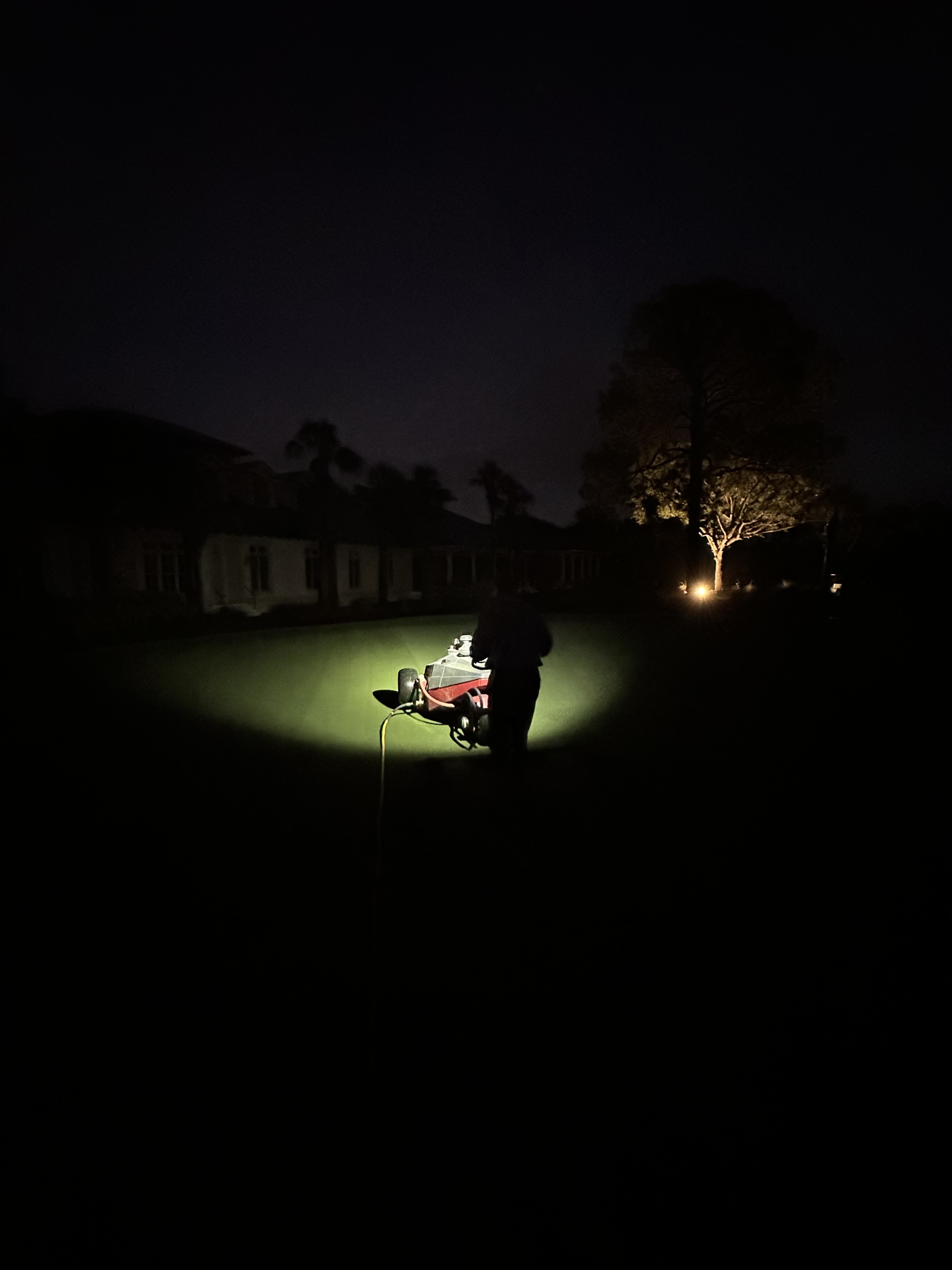
An employee wearing an LED headband while operating
the Hydroject on the practice green   
12/23/22

The agronomy staff begins work each morning at 6:00 a.m., with the exception of tournament days when the start time is as early as 4:00 a.m.. Most of the equipment at Olde Florida is outfitted with lights and employees are assigned LED headbands when needed.
 
When a greens foliar application of nutrients or a plant protectant is made portable LED light towers are also utilized. 

An American Alligator crossing 10 fairway   5/9/22

An Eastern Screech Owl with two eggs in her box
behind #12 tee   
4/19/22

Olde Florida has an abundance of wildlife that reside on and around the golf course.  

I am particularly pleased with the increase in our bird population. Since 2013 Olde Florida has worked with an ornithologist, Brian Beckner, Founder of Native Bird Boxes, Inc, to provide increased nesting opportunities for a variety of species. Though provided nesting structures, in particular, the Eastern Screech Owl and Purple Martin populations have soared.  In 2022 Olde Florida fledged 9 Screech Owls and 82 Purple Martins. 

Hole 1   10/24/22
 
Hole 4   3/12/22
    
4 green 12/12/22

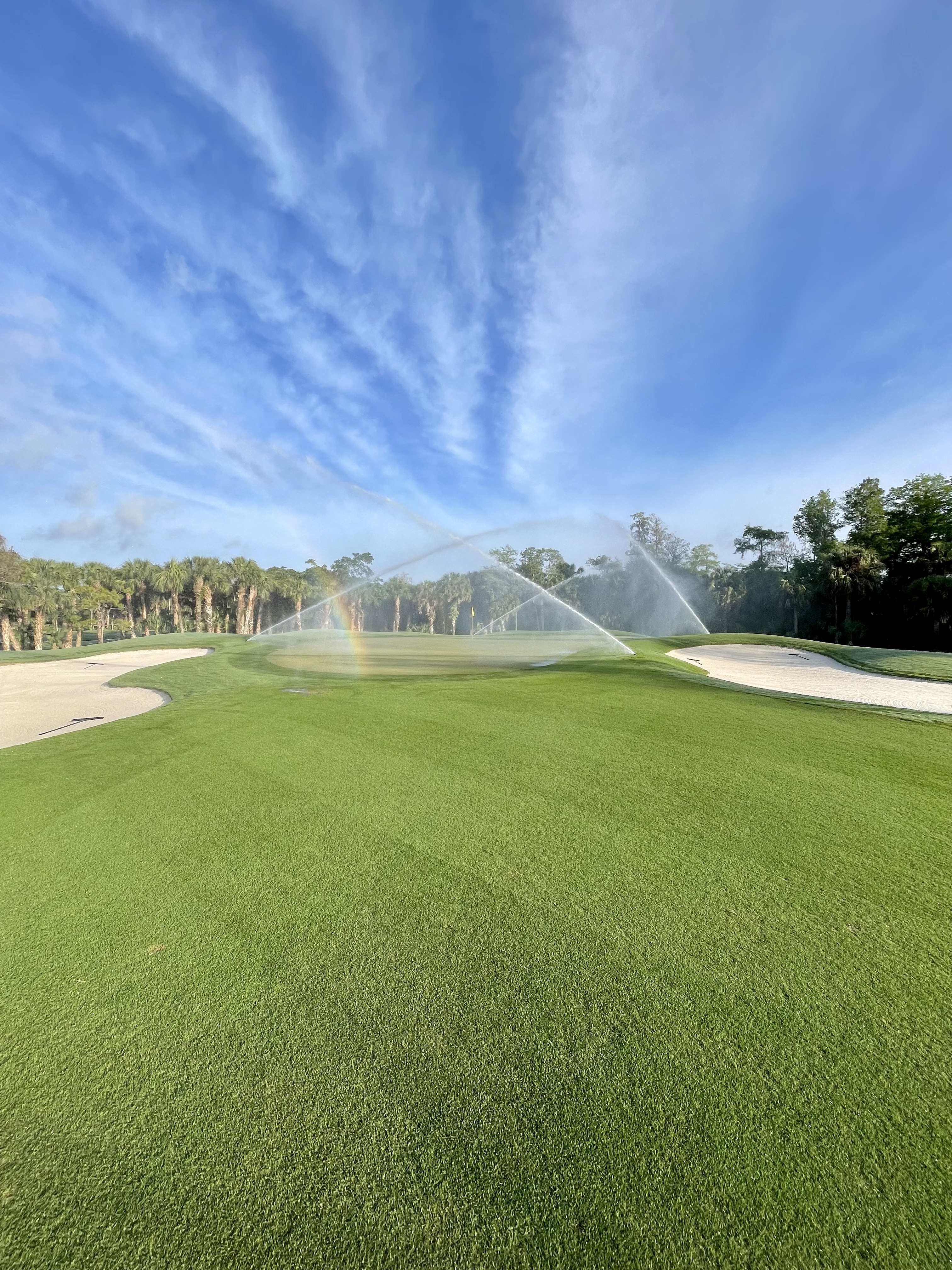
A modern, computerized irrigation system is instrumental in producing healthy turfgrass and a quality playing surface at Olde Florida. 

The water coming out of the 1,253 Toro "Infinity" series heads is also very majestic!

Frost on #1   1/31/22 
The winter of 2022 (both early, and at year end) was mild although Olde Florida did receive a significant frost on January 31. 

Fairway #12
Member/Guest Invitational Week   2/19/22
  
 
Olde Florida Logo on #1
Member/Guest Invitational Week   2/20/22

The annual Member/Guest Invitational is always a speacial week at Olde Florida Golf Cub

Sunrise, #1   3/5/22

Sunrise, Hole 10   10/12/22

Sunrise, Holes 1/10   12/13/22

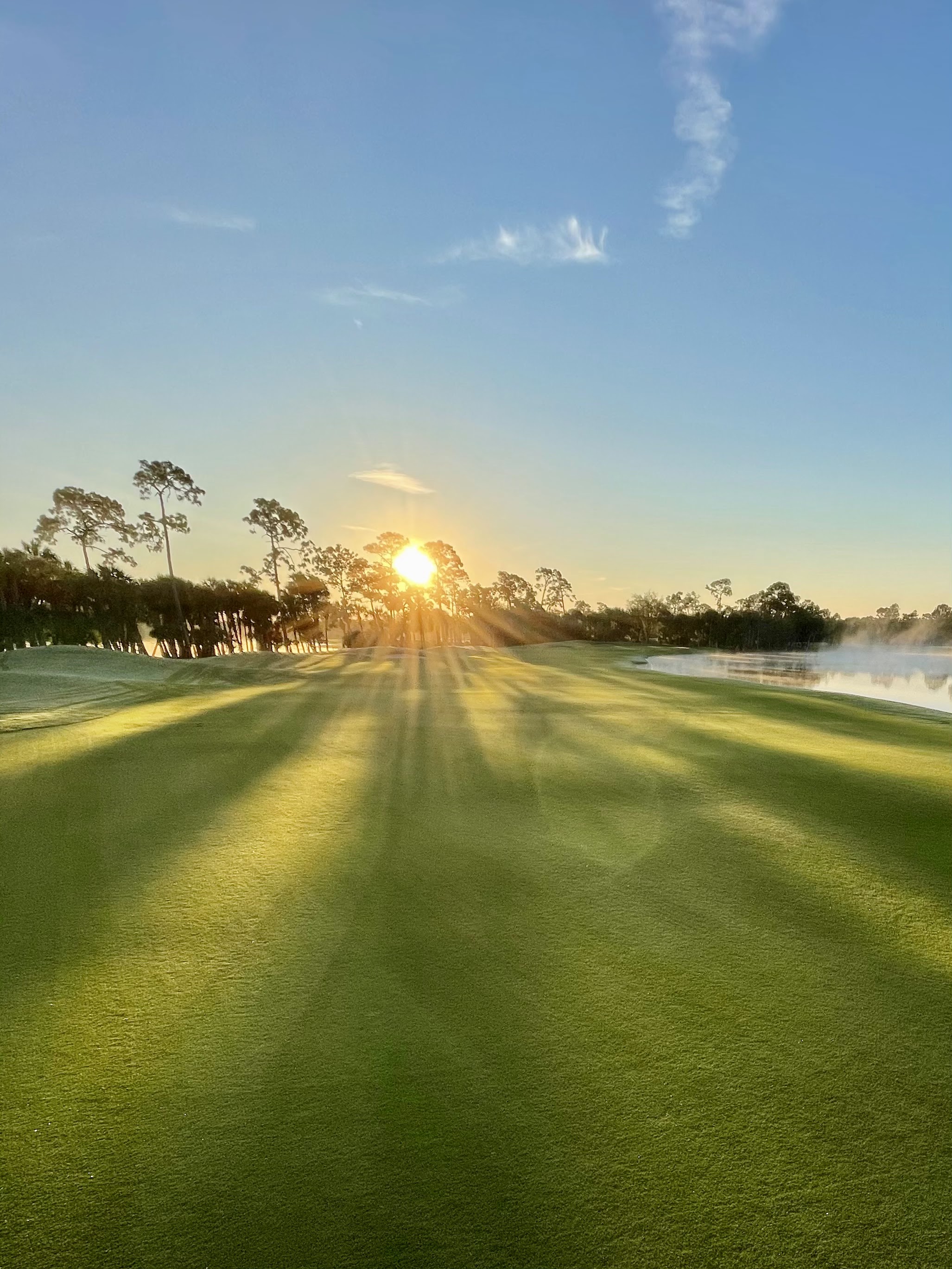
A sunrise is Nature telling you that it's time to cherish another day on Earth, and the opening hole of both nines at Olde Florida are a great place to start the day.

Drill & Fill, practice green   6/1/22 
 
DryJect   10/4/22 

Drill & Fill (circle in bottom) DryJect (sides)

Solid tine aeration, Hole 1   5/23/22

The summer months are when the agronomy staff performs various cultural practices, such as Drill & Fill and DryJect on the greens. 

Solid tine aeration was also performed on the entire golf course several times.
 
Practice green/clubhouse   9/30/22

Hurricane Ian, one of the strongest landfalling hurricanes in U.S. history powered ashore in Southwest Florida on September 28th as a category 4 storm with 150 mph winds and a devastating coastal storm surge. 

Fortunately the only impact to Olde Florida was wind damage to trees and scattered debris that took the agronomy staff numerous days to clean. 

Vertical-grooming, 16 green   12/7/22

Vertical-grooming, 16 green   12/7/22

Due to a La NiƱa weather pattern in December, Olde Florida experienced numerous record high temperature days. The heat and humidity were terrific for turfgrass growth. 

To increase green speed the agronomy staff "vertical-groomed" the putting surfaces throughout the month. Vertical-grooming removes leaf tissue and decreases leaf orientation increasing smoothness, trueness and the speed of the putting surfaces. 

I hope you had a wonderful holiday season and that you enjoyed this "Year in Review" through photographs.  

Here's hoping that 2023 provides a terrific year for you, your family and of course for your golf game!  
 

Wednesday, December 21, 2022

The Winter Solstice

Today is December 21... and all golf course superintendents in the south are keenly aware of the importance of this day. It means the winter solstice has arrived! This is a key date for those of us living in the northern hemisphere because it marks the shortest day of the year. 


The winter solstice is when the sun is directly over the Tropic of Capricorn, or 23.5 south latitude, which is the day when the sun rises and sets to our south at the lowest angle. Because the earth orbits around the sun on a tilted axis, between September and March the entire northern hemisphere gets less exposure to sunlight. It’s also not surprising that these months coincide with the seasonal influx of residents to Southwest Florida, and golf play is at its peak. 


So why is this important to a golf course superintendent? In basic terms, for turfgrass to thrive it needs sunlight, water, air and nutrients. Of these needs, the one that is least in a golf course superintendents control is sunlight. This is why an understanding of the earths rotation and the winter solstice is vital. Also influenced by the angle of the sun are air and soil temperature. Bermudagrass, the turfgrass that comprises the playing surfaces at Olde Florida, is a warm season turfgrass. Warm season grasses grow best when the average daily temperatures are above  75°F.  In addition, soil temperature, as influenced by air temperature is also important to the growth of bermudagrass. Soil temperatures above 65°F are required for significant growth, and the optimum soil temperature for root growth is around 80°F. 


Since the duration and intensity of the sun's rays (and air and soil temperature) is out of our control, it is extremely important to have plant health peaking on this day and then do everything in our control to maintain plant health for the next 60 days or so. By March, the nighttime temperatures have increased, the sun is high enough in the sky and  the days are long enough that sunlight essentially becomes a non-factor.


December 2022


Holes 8 and 9 are the southernmost holes at Olde Florida. Both play from east to west, so on December 21 the sun rises to the southeast of  8 and 9 tee and it sets to the southwest of  9 green.  


Tomorrow, the day AFTER the winter solstice, the sunrise and the angle of the sun will slowly begin to shift to the north. This will bring a little more sunlight to our turfgrass each day!