Thursday, January 4, 2024

El Niño and its Effect on Turfgrass Management

After years of back to back La Niña winters in Southwest Florida, we are experiencing our first El Niño weather pattern since 2018-2019. El Niño is a climate interaction linked to warming sea temperatures in the central and east/central Pacific Ocean. The warmer waters cause the jet stream to move south of its typical position. 

During an El Niño winter the southern third to half of the United States experiences cooler than normal temperatures, increased cloud cover and an enhanced chance of precipitation. 

Forecasters for the National Weather Service have said there is a greater than 55% chance of a "strong" El Niño weather pattern and there is even a 35% chance that it ends up being one of the strongest ever, like the ones we saw in 2015-2016 or 1997-1998. 

NOAA Seasonal Precipitation Outlook for January - March 2024


NOAA Seasonal Temperature Outlook for January - March 2024


As a result of back to back La Niña winters, the weather in Southwest Florida the last three winters was exceptional. In a La Niña winter the climatical conditions favor warm-season turfgrass growth. The above average temperatures, lower than average rainfall and bountiful sunshine enable turfgrass to thrive. The weather, combined with management by the agronomy staff produced exceptional conditions at Olde Florida! This also allowed us to be very aggressive with vertical grooming and maintain very low heights of cut on putting surfaces, resulting in exceptionally quick green speeds.

Winter rainfall is dramatically different in El Niño, Neutral and La Niña weather periods

An El Niño winter creates challenges for growing turfgrass (or any crop) in Southwest Florida. Fortunately, as is the goal every year, we entered winter with very healthy turfgrass. This is in large part due to the cultural practices we perform in the summer. Aerification, topdressing and all of the off-season turfgrass management enable us to survive the busy winter golf season, even when the weather is least conducive to warm season turfgrass growth. You can read more on the challenges of growing warm season turfgrass in the winter in my recent blog entry: "All I want for Christmas ... is sunshine!"


South Florida Experienced the Cloudiest December since 1940

This year, as we entered December it became obvious the El Niño forecast was correct and we reacted quickly. Our management in December and January has been drastically different from previous winters!  Due to reduced sunlight and cooler temperatures turfgrass growth quickly and drastically declined in late November. 

Among other things, growth regulation was halted, the height of cut on greens and fairways was increased and mowing frequency reduced. The advantages of both include reduced stress, increased leaf tissue and consequently deeper rooting.  Increased leaf tissue also enhances photosynthesis. Without getting deep into plant physiology, a plant needs sunlight to survive and it's the leaf tissue that absorbs sunlight enabling photosynthesis and subsequent growth. 


Although we raised the height of greens in December, I would point out that the increase was extremely minimal. Our lowest height of cut on greens in the 2023-2024 winter season had been .090". Our current height of cut (on January 4th) is .115". The difference in our lowest to our current height of cut is .025". To give perspective on this slight change, the diameter of a US dime is .053. Consequently, the raise in our height of cut is LESS than one-half the thickness of a dime.  

Disease pressure this winter has also been amplified by low light, cool temperatures and moist/saturated conditions combining to weaken the plant and create a desirable habitat for pathogens. We implemented several practices to elevate this challenge. We began needle tine and air injection practices on the greens. This increases air into the subsurface increasing drainage and soil oxygen, as well as relieving compaction. 

We also significantly increased our applications of plant protectants on tees, greens and even fairways. On greens, all potential soil and leaf diseases were addressed preventatively with systemic fungicides, and when needed correctively with contact fungicides. We also increased the frequency of light rates of foliar fertility on greens to try and encourage growth in this period when the plant is not actively growing from the nitrogen in the soil.     


Monday, January 1, 2024

Year in Review: 2023 in Photographs

A new year brings excitement for the future, but it's also a good time to reflect on the past. I find that self reflection provides the opportunity to appreciate the things you experienced and discovered, as well as determine the things that made you happy. I enjoy photography so one way I reflect on the previous year is to sort through photos I took in the last 12 months. These are a few of my favorites.    

The north range tee at sunrise 1/7/23
10 green at sunrise, 1/8/23
A light frost on hole 1, 1/16/23
Using irrigation to remove frost at sunrise, 1/16/23
We had another very successful Patriot Golf Day at OFGC to benefit the Folds of Honor Foundation, 1/28/23
Using the Toro Hydroject on 8 green, 2/3/23 
I had several speaking engagements in 2023. In February I spoke twice (2/20 & 2/21) to the Northern California Golf Course Superintendents Association.  I had an afternoon free so I visited my good friend Jeff Markow, golf course superintendent at the Cypress Point Club. 
The Olde Florida Golf Club logo behind 1 tee - a tradition for the annual OFGC Member/Guest Invitational, 2/23/23
Sunrise on 10 green, 2/25/23
Sunrise on hole 1, 3/11/23
In March I spoke twice (3/14 & 3/15) to the Inland Empire Golf Course Superintendents Association. After one of my presentations I enjoyed a visit with a fellow GCSAA Past President, Sean Hoolehan at his course Wildhorse Resort and Casino in Pendleton, Oregon  
It was another very successful Screech Owl nesting season at OFGC. In total we had ten hatchlings from three mothers, 3/16/23  
Hole 5, 4/2/23
Clubhouse, 4/2/23
Hole 5, 4/24/23
Fairway sand topdressing on hole 1, 6/1/23
Sunrise on hole 1, 6/3/23
Fairway mowing on hole 6, 6/30/23
The road to Augusta came through Olde Florida Golf Club in August. Over 100 participants competed in a sub-regional qualifier for the annual Drive, Chip & Putt competition held at Augusta National Golf Club during Masters week, 8/26/23 
A morning syringe on 7 green, 8/29/23
In September I was fortunate to participate in a pro-am tournament at Pinehurst. We played two rounds on  Course 2, one on Course 4 and a round on The Cradle (par 3 course), 9/19/23  
In October I spoke to a group of assistant golf course superintendents in the Nufarm Excel Leadership Program held at GCSAA headquarters in Lawrence, Kansas. This quote and photo of GCSAA Founding President is in the foyer of the GCSAA headquarters, 10/5/23  
An early morning view of the clubhouse, 11/7/23
Rainfall in 2023 was very unusual. We had a drier than normal rainy season and we are experiencing a strong El Niño weather pattern (cooler and wetter) this winter. OFGC practice green, 11/5/23 
Sunrise hole 2/10, 11/28/23
If I am not watching the sunrise at OFGC, a favorite place for me to experience it is leaving Goodland, Florida on a Sunday morning fishing trip in the 10,000 Islands, 12/3/23
A light syringe being applied on 16 green, 12/12/23

This year I began creating videos on the TikTok platform. Here are a few of my favorites from 2023

Morning turfgrass maintenance, 5/26/23  


Sunrise on hole 10, 8/22/23

Thursday, December 21, 2023

All I want for Christmas... is sunshine!

Today is December 21... and all southern golf course superintendents are aware of the importance of this day. It means the winter solstice has arrived! To be exact, it will arrive at 10:27 p.m tonight. This is a key date for those of us living in the northern hemisphere because it marks the shortest day of the year. 


The winter solstice is the day when the sun rises and sets to our south at the lowest angle. Because the earth orbits around the sun on a tilted axis, between September and March the entire northern hemisphere gets less exposure to sunlight. It’s not surprising that these months coincide with the seasonal influx of residents to Southwest Florida, and golf play is at its peak!


Sunrise on Hole 10, Winter 2023


So why is this important to a golf course superintendent? In basic terms, for turfgrass to thrive it needs sunlight, water, air and nutrients. Of these needs, the one that is most out of our control is sunlight!


Since the duration and intensity of the sun's rays is out of our control, it is extremely important to have plant health peaking on this day and do everything in our control to maintain plant health for the next 60 days or so. By March, the nighttime temperatures have increased and the days are long enough that sunlight essentially becomes a non-factor.


This year sunlight is especially important because we are under the influence of a strong El Niño weather pattern. This means a cooler and wetter than normal winter in Southwest Florida. While we appreciate  rainfall in the dry season, a potential negative is the increased cloud cover. This has been evident over the last few weeks, and the forecast for the foreseeable future is for the cloudy days to continue. Since we are in our peak golf season, and the weather has been less than conducive for warm season turfgrass growth, we are managing the turf significantly different than most years. The mowing height on greens has been increased slightly and we have even skipped mowing greens, opting for a “roll only” several days a week. In the winter it's a normal practice at Olde Florida to be on a "preventative" fungicide program, but this year the window on these applications have been tightened. 


We are also mowing fairways less frequently to maintain as much leaf tissue as possible. Leaf tissue is essential for effective photosynthesis and plant growth. Finally, with the lack of turfgrass growth this time of year (even more so this year) traffic and the resulting wear patterns (weakening turf) will remain a concern for us.  


Fortunately, on this winter solstice we have complete turfgrass cover on all playing surfaces at Olde Florida, but for this golf course superintendent, all I want for Christmas is sunshine!

Tuesday, August 1, 2023

Drainage... Drainage... Drainage!

While attending The Pennsylvania State University in 1991, my mentor and famed turfgrass scientist, Dr. Joe Duich asked my fellow students and I, “What is the most fundamental aspect of successful turfgrass management?”  Dr. Duich, known for his wit and challenging teaching style had many leery to respond. After a few failed attempts by my classmates to answer his question, Dr. Duich responded, “It’s not rocket science, if you want to be successful at growing turfgrass, you need drainage... drainage... drainage!" He continued, "Surface drainage, air drainage and subsurface drainage are all critical" 


Once a golf course is constructed and open for play, surface drainage can be increased by adding catch basins and piping to a water body or slope can be modified through a renovation. Air drainage can be enhanced through underbrush or tree removal (or fans), but are not an option for everyone. However, subsurface drainage is an annual process on almost all golf courses. Subsurface drainage is partially managed through aerification and topdressing, which we do a significant amount of at Olde Florida. However, it can be impacted more significantly through the installation of subsurface drainage.   


This summer my staff installed 1,700 linear feet (1/3 of a mile) of subsurface drainage. This brings the total subsurface drainage, or what some refer to as a "French drain" that my teams have installed in my 31 years as the golf course superintendent at Olde Florida to over 16 miles.  


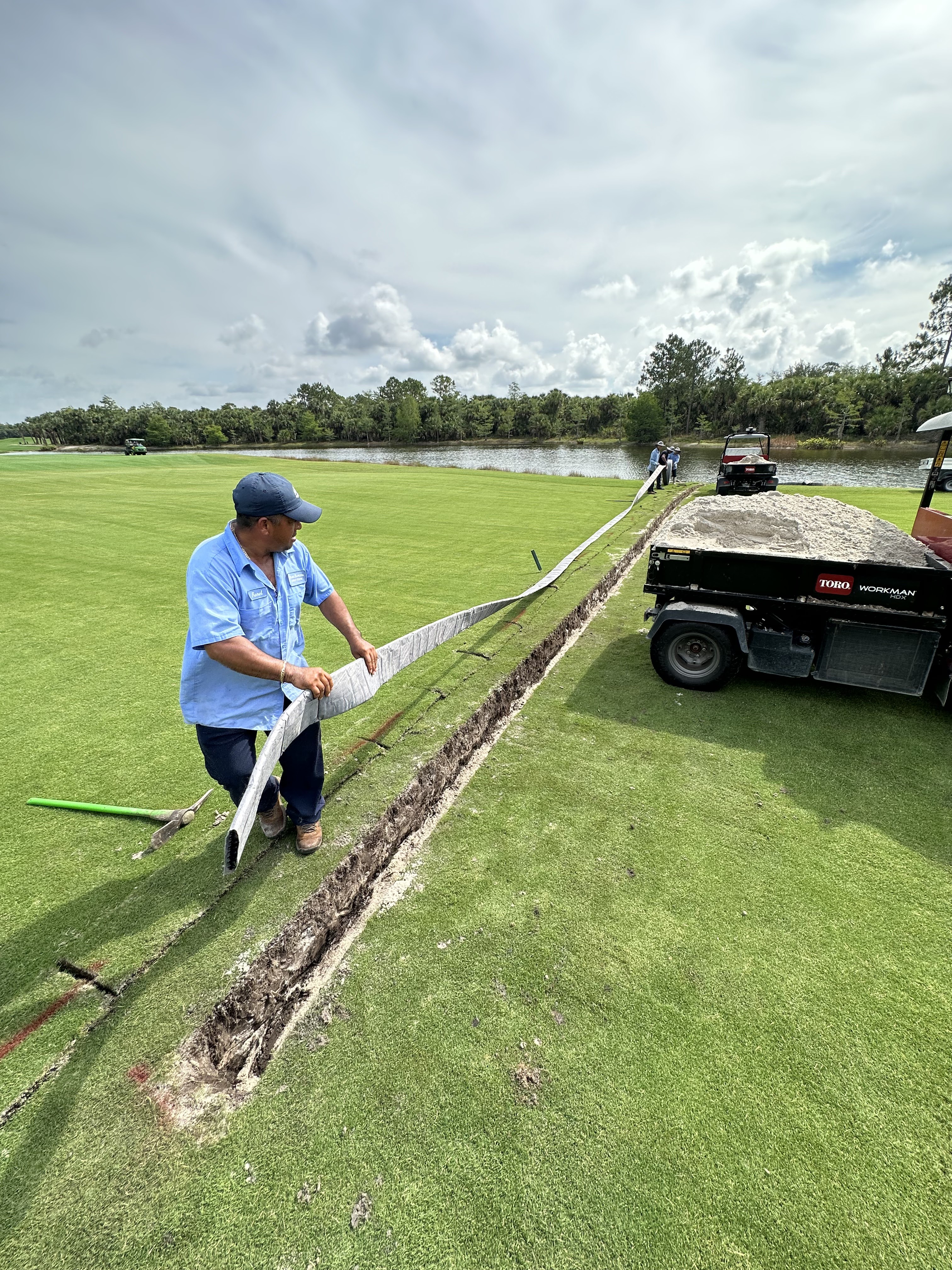
The steps in our drainage installation at Olde Florida are fairly simple. First we analyze the area and figure out the best method to get water from “point A to point B”. Once analyzed and determined I paint the drainage project on the turf with a paint gun (the easy part). My assistants then consult our irrigation as-built, a wire tracer, etc., to determine if there are any subsurface items that the staff will need to avoid. Next, a sod cutter with a 12-inch blade is used to remove the turfgrass, and then the hard part begins, the excavation of the soil (and often rock) to a depth of 18 inches and a width of 12 inches. Finally flexible drainage pipe is laid in the bottom and center of the trench, coarse sand (gravel in the past) is carefully installed, compacted and then the sod (with minimal thatch) is re-installed. 


Trench Excavation 

TurfDrain Rolled Out 


TurfDrain Ready for Installation 

Sand Being Added to Trench


TurfDrain / Sand Installation 

Sod Re-installation


Often when installing drainage we discover existing drainage that was installed at some point over the last 31 years. While still effective in receiving subsurface water moving laterally in the soil, many have lost effectiveness of moving water downward from the surface into the drainage system due to natural buildup of thatch/organic material. 

Existing Drainage (Old) with 6" of Organic Matter Above  

Existing Drainage (Old) 8" Below Surface


This summer drainage projects included an area in front of #2 approach, in the swell to the left of #3 green, an area at the front right-side of #6 fairway, the chipping area to the right of #6 green, four separate projects on #16 fairway and two projects on the east chipping green.  


Hole #2

Hole 2 


Hole #3 


Hole #6 


#16 Fairway

More information on the TurfDrain product can be found here.


Tuesday, July 4, 2023

“Why do you aerify greens when they are in great condition?”

A common question in the golf industry is, “Why do you aerify greens when they are in great condition?”  The quick answer is that weather plays a large role in recovery. Therefore, performing aeration when the weather favors turf growth leads to quicker recovery. Aeration is also stressful on turf so performing the task when the turf is in "great" condition is also vital. 

Practice Green 7/4/23 - 7 Days after Aerification 

We are fortunate in Southwest Florida this coincides with the time of year the majority of the membership has left for the summer. At Olde Florida we perform various types of aeration throughout the summer; however, we are most aggressive in the early to mid-summer. One reason is the days are the longest. The summer solstice (longest day of the year) was June 21. 

We also want to perform aggressive aerification earlier in the summer to avoid cloudy, rainy days. Weather is obviously unpredictable, but in general as summer in Southwest Florida progresses, we see an increase in cloudy weather. Clouds and rain reduce sunlight, and sunlight is essential to warm season turfgrass recovery. Historically we also have a greater likelihood of severe weather from tropical systems or hurricanes as the summer progresses. The negative impacts from severe storms could delay or cancel scheduled procedures, or at a minimum slow the turf recovery. 

Topdressing - Practice Green 6/26/23

Core Aeration - Practice Green 6/26/23

Another question that is sometimes asked in the golf industry is simply, “WHY do you aerate?”  At its most basic, aeration helps keep soil "healthy" and healthy soil plays a significant role in healthy turfgrass. 
Agronomy textbooks teach that “healthy soil” consists of:
  • 45% solids 
  • 25% air 
  • 25% water 
  • 5% organic material 
"Healthy Soil" - Practice Green 

In more detail, when done in conjunction with sand topdressing core aeration: 
  • Reduces compaction 
  • Dilutes organic matter 
  • Improves infiltration 
  • Increases oxygen exchange 
  • Reduces dry spots 
It’s also important to vary the depths of aerification practices to prevent the development of compacted layers in the soil profile. At Olde Florida we utilize two processes to achieve this, the Drill and Fill and the DryJect aerification methods. Both have advantages, and most years we will contract one of each. 

With the Drill and Fill soil is brought to the surface and the holes are filled with kiln dried sand. The diameter and length of the bits are customized to each property At Olde Florida we utilize a 1" bit, set to a depth of 10”. The top 7-8” of our greens profile is the zone that we have organic buildup from 31 years of growth. 

Drill and Fill - Practice Green 5/30/23


Drill and Fill (video) - Practice Green 5/30/23
  
The Dryject has a quicker recovery time than the Drill and Fill, but the depth can be variable depending on soil conditions. Also, no organic material is removed with the DryJect. At the end of summer, after numerous cultivations we can achieve a sand depth of approximately 7” with the DryJect Maximus process. 

DryJect - Practice Green 10/4/22


DryJect (video) - Practice Green 10/4/22
 
Our goal has been, and will always remain to perform the more aggressive cultural practices during one of the five, week-long closures to reduce the impact to our summer players. 

When conditions do not favor quick recovery we also utilize several less aggressive aeration processes. These include; "Ninja tine," "needle tine," and water injection aeration. The Ninja tine is fairly new to the industry, but it's gaining popularity due its ability to pull a consistent small core; consequently, removing organic matter with minimal disruption. The needle tine and water injection aeration methods do not "pull a core" so no organic material is removed. These practices have no impact on the surface and most players never know the procedure has been performed.


The Hydroject - 8 Green 2/23/23