Thursday, May 12, 2022

Enhancing Nature at Olde Florida Golf Club

In 2013 Olde Florida Golf Club began a program to enhance nesting opportunities for Purple Martins, Screech Owls and Eastern Bluebirds. Working with an ornithologist, Olde Florida installed and monitors seven Screech Owl boxes, two Purple Martin nesting structures and two Eastern Blue Bird boxes. 

Ornithologist, Brian Beckner
Founder, Native Bird Boxes, Inc.


Screech Owl Box, 14 Green

Screech Owl’s are a robin-sized night bird. They are common in city parks and suburbs, where many human residents are often unaware they have an owl for a neighbor. The owl spends the day roosting in holes, nesting boxes or in dense cover and become active at dusk. 

This mother, affectionately named "Stink eye" once again returned to her nesting box behind 12 tee

"Stink eye" shortly after one of her two hatchlings emerged from the egg


"Sleepy" also returned to her nesting box in front of the clubhouse 

"Ginger" cuddling with one of her hatchlings
"Ginger" has utilized the nesting box behind 5 green for many years  

Of the seven Screech Owl "Native Bird Boxes" at Olde Florida, this year four are being utilized. Screech owls often return to the same nest each year. All four of this years mothers have previously utilized their nesting box and this year they have laid a combined seven eggs. 

"Sleepy's" two hatchlings will be leaving the nest soon

Olde Florida also installed and maintains two Purple Martin structures and once again both are being fully utilized. When inspected this week there were 19 nests with a combined 82 eggs/hatchlings. 


A few of this years Purple Martin hatchlings 

Purple Martins migrate each winter to South America. However, they remain incredibly faithful to their colony (nesting) sites each year, often returning to the United States about the same date.


Purple Martins are quite friendly and prefer to nest in close proximity to people, which make golf courses a perfect location for the bird. Interestingly, Purple Martins are the only bird species that is totally dependent on human supplied nest boxes. Qualities that make the martins desirable are they nest in colonies and have fascinating social behavior. Their vocalizations are also quite beautiful, they are extremely graceful in flight and they consume vast quantities of insects.


Monday, April 4, 2022

Annual Report to the Olde Florida Golf Club Membership

First and foremost, I’m pleased to report that our 2021 golf course renovation was completed on time and on budget. Even with supply chain challenges, due to the advanced preparation and strong partnerships the project went smoothly. Golf Course Management published a story in the December issue on the renovation, Olde is New Again

First Tee Shot on Opening Day, November 1, 2021 


A few things I would highlight on the renovation:

First, I am pleased with the eradication of the old bermudagrass. This is an extremely difficult process. We followed the data that was published in 1988, 1999 and most recently in 2001. The data from each of these bermudagrass eradication research projects demonstrated that multiple applications of non-selective herbicides at reduced rates are necessary to achieve 96-98% eradication. Furthermore, the applications need to be at least 30 days apart when the turfgrass is actively growing.  

To encourage regrowth of our existing bermudgrass between herbicide applications, we provided the proper frequency and quantity of irrigation water as well as light frequent nitrogen applications. We also incorporated fraise mowing after the second herbicide application which removed approximately 1 1/2" of material. I am very pleased with our efforts and we were able to achieve 99% eradication. Only in the last few weeks have we been able to find an extremely small amount bermudgrass that survived, or common bermudagrass that established itself from seed. We will address these small areas this summer so that we can continue to provide as close to a mono turfgrass stand as possible. 

As I have explained in the past, in the south common bermudagrass is similar to Poa annua in the north. Both are viable from seed and extremely difficult to keep out completely. The research that we relied upon as well as more information on the eradication process at Olde Florida can be found in the blog entry, Glyphosate Usage at Olde Florida Golf Club / Part 2

Second Herbicide Application on Hole 1, April 2021

The second item I will highlight is the bunker renovation. 20% of the project budget was dedicated to the renovation. The bunkers were original construction (1992) and had lost some of their contouring. With the help of Greg Muirhead, Senior Vice President of  Rees Jones, Inc., we regained the original contouring and made a few subtle changes. We used the Better Billy Bunker method of construction, which I am pleased to report has performed phenomenally. Information and videos explaining the Better Billy Bunker method can be found in the 2021 Renovation Update #2 - Bunker Renovation

Other subtle changes on the golf course are too numerous to list, but two that I would touch on are the lank bank restoration work and the lowering and expansion of numerous tees. The lake bank restoration work was a significant aesthetic improvement to the golf course. A more detailed explanation of the restoration can be found in the 2021 Renovation Update #6 - Lake Banks

The work on the tees has provided more teeing ground, better turfgrass and the reduction of tee bank slope enables a more enjoyable, shorter walk to tees from the path. More of the ancillary projects are detailed in the 2021 Renovation Update #7 - The Homestretch

12% of the renovation budget was utilized to do an irrigation update. All of the 1253 irrigation heads and the 34 field satellites were replaced.  In addition to better water distribution, an advantage of the newly installed “Infinity” sprinkler is the ability to service components from the top of the head.  We sold the used components to recover 16% of the cost of the new sprinklers and field satellites. The system is functioning extremely well. A more detailed report of the irrigation work performed during the renovation can be found in the 2021 Renovation Update #5 - Irrigation

Hole 10

The 2021/2022 Winter Golf Season 

Overall the winter was good for turfgrass growth.  November and December were phenomenal weather months with numerous record high temperatures. This was welcomed as it enabled us to continue turfgrass establishment. January and February did have several below average days, with more fog and cloud cover than desirable. And, on January 30th and again on the 31st we experienced our first significant frost in over 4 years. Fortunately, that is behind us and the TifTuf is flourishing with the warm weather and longer days. Information on the development and some of the positive attributes of TifTuf can be found in the 2021 Renovation Update #3 - TifTuf Bermudagrass

Hole 11, 2022

We are doing our best to control costs, but just as your businesses or personal budgets are experiencing, the increase in the cost of goods is creating challenges. Finding and retaining labor has been a significant challenge for all businesses. 62% of our budget is payroll and payroll related expenses so increased labor expense is significant to our bottom line. Other key areas where rising costs have been a challenge for us are fuel and fertilizer. These two items account for another 10% of our annual operating budget.
   
I sincerely appreciate the extremely positive feedback on our TifEagle putting greens this year. We check speed on two greens daily in the winter season and our speed has been in, or exceeded our target zone almost every day.  

The greens are original construction, so they are now 30 years old.  The original TifDwarf bermudagrass was replaced with TifEagle in 2000 so the current turf is 22 years old. I was onsite in 1992 so I am very comfortable in the construction and my staff and I have provided proper management for 30 years. 

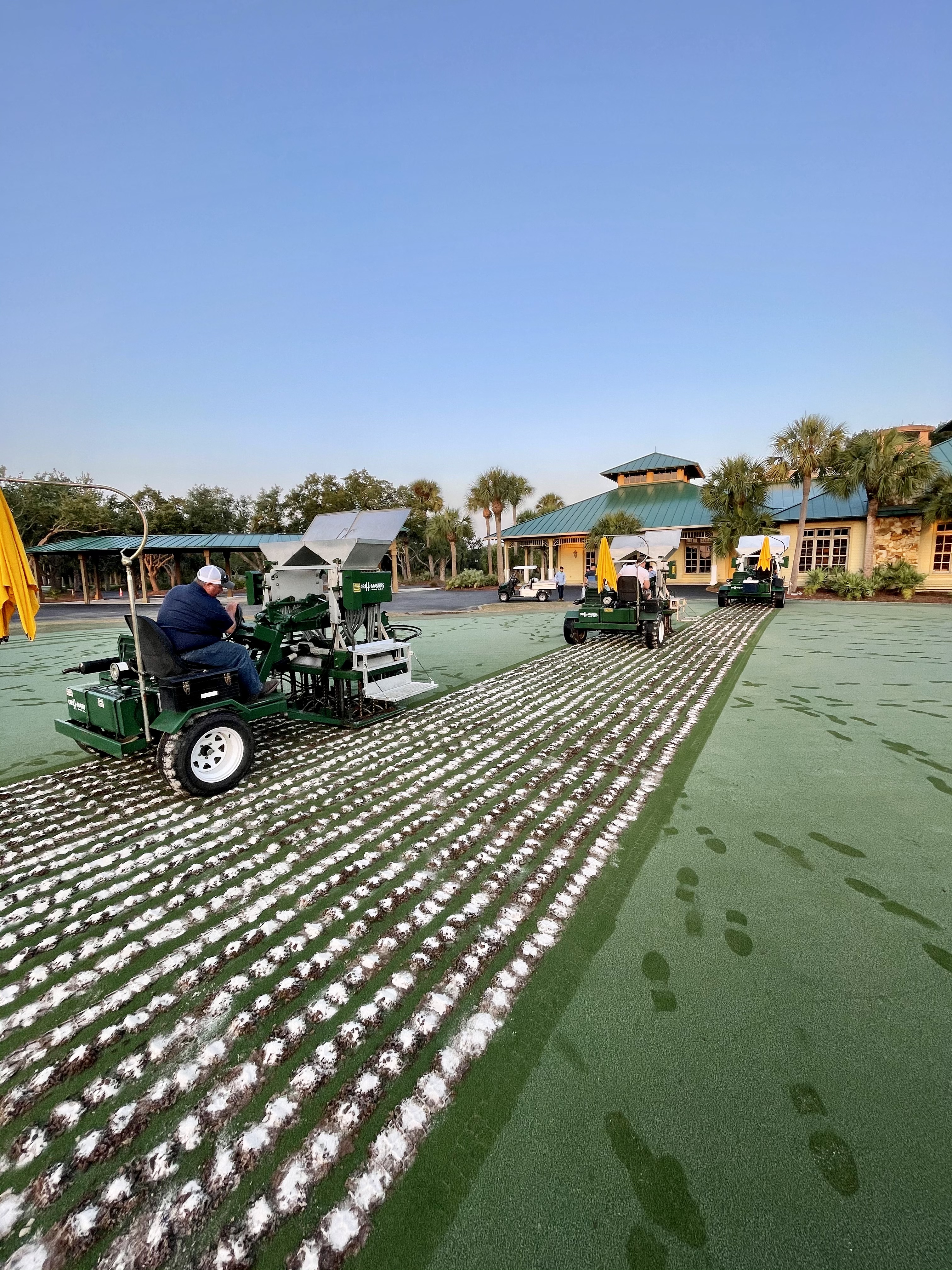
One recent change in management began in 2020 and repeated in 2021. In order to extend the life of the greens we have utilized the Drill and Fill and DryJect processes. Both processes provide deep aerification (7-10”) and soil modification. These practices will continue as an annual summer treatment in the future. A detailed report on the greens at Olde Florida can be found in the blog entry, Extending the Performance of 27-Year Old Putting Greens

"Drill and Fill" on the Practice Green, April 2021

Finally, I want to sincerely thank the vast majority of the membership that are following proper golf car etiquette. As members you are owners, not just consumers of this wonderful facility and the playability and aesthetics of your golf course have been greatly enhanced due in part to you adhering to good etiquette. Your fellow members and I thank you! 


Sunday, January 30, 2022

Olde Florida Golf Club's streak ends at 1472 days!

It has been 1472 days since Southwest Florida has seen a low temperature as cold as we did this morning! The air temperature (measured at 4’) dropped to 35 degrees; however, the ground temperature was even colder. At sunrise the temperature of the turfgrass was 31 degrees. 


1/30/2022 - 7:30 a.m


A frost typically occurs when the sky is clear and the air close to the ground drops to 32 degrees. When a frost occurs, the grass blades internal water freezes causing its cells to expand and rupture. Driving or even stepping on frozen turfgrass causes the ice to penetrate more deeply increasing the damage. Cart or foot traffic on turfgrass when the leaf blade is frozen is like stabbing it with an "ice dagger." 


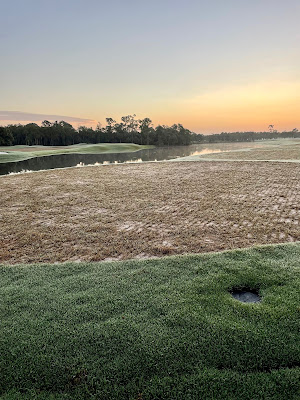
Even without cart or foot traffic, a frost will have a visual effect on our TifTuf bermudagrass. Over the next few days some of the turfgrass will turn brown and have patchy appearance. Fortunately, with the favorable forecast beginning this Tuesday (2/1/2022) the look will be short lived. Some examples of what you might see over the next week are below. 


1/27/2014 - Hole 12 Olde Florida 

1/27/2014 - Hole 12 Olde Florida


With the lake water temperature being significantly warmer than the air and ground temperature, once the sun is high enough in the sky and the ground temperature is above freezing, the agronomy staff utilizes the irrigation system to knock off the frost so we can get play on the course quicker.


1/30/2022 - Hole 1


A Short Agronomy Lesson:

Bermudagrass is a warm season perennial species adapted to tropical and subtropical climates. It grows best under extended periods of high temperatures, mild winters and moderate to high rainfall. Extended temperatures below 30 degrees can kill bermudagrass. 


Bermudagrass grows best when the average daily temperature is above 75 degrees. Soil temperature is also very important to the growth of bermudagrass. Soil temperatures above 65 degrees are required for significant plant growth and the optimum soil temperature for root growth is around 80 degrees.


1/30/2022  8:50 a.m. - Soil Temperature Practice Green 

Golf Cart Etiquette 

Golf cart etiquette this winter has been very good, certainly much improved over previous years. As a result we are seeing and playing off turfgrass this winter that is healthier and has better vigor.


With the extended cool streak we have been experiencing over the last few weeks, and now with a frost, golf cart traffic will inevitably become more evident. More than ever continued good etiquette (staying on paths around tees and greens, staying outside of the green/white posts and just generally dispersing cart traffic on turfgrass) is important and will be very much appreciated by all golfers. 


Wednesday, January 5, 2022

Golf Course Management - "Olde is New Again"

The December issue of Golf Course Management magazine included a story on the recent renovation at Olde Florida Golf Club. The title of the story is "Olde is New Again," and it begins with, "Led by a former GCSAA president, venerable Olde Florida Golf Club undergoes the most extensive renovation in its 29-year history." The remainder of the story can be downloaded by clicking on this link: "Olde is New Again"
Lead Photo in "Olde is New Again"
Golf Course Management is the monthly publication of the Golf Course Superintendents Association of America (GCSAA). Founded in 1926, GCSAA is the leading course management association in America. GCSAA is the professional association for the men and women who manage and maintain the game’s most valuable resource — the golf course. 

Cover of the December Golf Course Management  

GCSAA provides education, information and representation to over 18,000 members in more than 78 countries. Its mission is to serve its members, advance the profession and enhance the vitality of the game of golf. The golf industry recognizes the association as a key contributor in elevating the game and business, which makes it truly an honor for me to have served as the associations 82nd president in 2018. 


Tuesday, December 21, 2021

Today is December 21, which among other things means it’s the shortest day of the year at Olde Florida!

Today is December 21!  This is important for several reasons! First, it means Christmas is almost here! December 21 also means the winter solstice has arrived! This is a key date for those of us living in the northern hemisphere because it marks the shortest day of the year. 

The winter solstice is when the sun is directly over the Tropic of Capricorn, or 23.5 south latitude, which is the day when the sun rises and sets to our south at the lowest angle. It also marks the first day of winter. Because the earth orbits around the sun on a tilted axis, between September and March the entire northern hemisphere gets less exposure to sunlight. Because of our location, it’s also not surprising that these months coincide with the seasonal influx of residents to Southwest Florida and golf play is at its peak. 

In basic terms, for turfgrass to thrive it needs sunlight, water, air and nutrients. Of these needs, the one that is least in a golf course superintendents control is sunlight. This is why an understanding of the earths rotation and the winter solstice is vital. Also influenced by the angle of the sun are air and soil temperature. Bermudagrass, the turfgrass that comprises the playing surfaces at Olde Florida, is a warm season turfgrass. Warm season grasses grow best when the average daily temperatures are above  75°F.  In addition, soil temperature, as influenced by air temperature is also important to the growth of bermudagrass. Soil temperatures above 65°F are required for significant growth, and the optimum soil temperature for root growth is around 80°F. 

 Since the duration and intensity of the sun's rays (and air and soil temperature) is out of our control, it is extremely important to have plant health peaking on this day and then do everything in our control to maintain plant health for the next 60 days or so. By March, the nighttime temperatures have increased, the sun is high enough in the sky and  the days are long enough that sunlight essentially becomes a non-factor. 

The sunrise this morning, December 21, 2021

8 and 9 are the southernmost golf holes at Olde Florida. Both play from east to west, so the sun rises to the southeast of  8 and 9 tee and it sets to the southwest of  9 green.  On the day AFTER the winter solstice, the sunrise, sunset and the angle of the sun will continue to shift to the north bringing it more over hole 1 (pictured above). This will also bring a little more sunlight to our turfgrass each day! 

Thursday, October 7, 2021

2021 Renovation Update #7 - The Homestretch


As I reflect on the project this summer, it truly seems like yesterday that we began the renovation. The vast majority of days since our April 19th closing, my staff and I pulled through the gates of Olde Florida before sunrise, and more often than not we chased the sun to the west as we went home. 
    
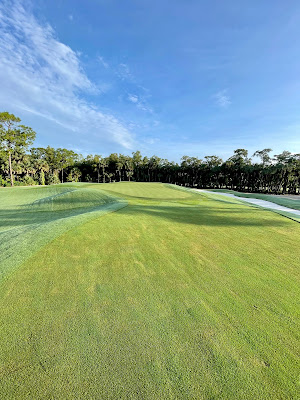
Hole 1 - September 24, 2021

The years of planning, combined with strong relationships in the industry played an important role in our success. Even with supply and demand challenges we completed the project without significant issues or major increases in pricing.  

We will open on schedule and have good turfgrass coverage on all golf holes. Depending on when you arrive in Southwest Florida, you might be able to tell a difference between some holes. This is due to the timing of when holes were grassed. 

I hope you will take the time to read this final update, but before you do I want to ask you for help. I am asking you to help me... help you. My team and I want to provide you, your guests, your fellow members and their guests with the best conditioned and most aesthetically pleasing golf course possible. To do this we need your help. 
There is a misconception among some that you can drive wherever you want at Olde Florida without consequence. There is a consequence. 
With a full and active membership golf car traffic does and will impact your enjoyment of the golf course. ALL turfgrass regardless of age or geographical location will wear and eventually die from traffic. This is why we are asking that you to PLEASE give consideration on your actions and how it will impact the playability and aesthetics of YOUR golf course. 

Proper golf car usage is important every year, but even more important when the turfgrass is new. As you will read below (and you will soon see) we have made numerous changes on the golf course that make the distance you walk to a tee shorter, as well as the severity of the slope you traverse to a tee or green much less.  

Grassing Update
As you probably recall from previous blog entries, due to access issues, we completed the furthest southeast holes first (3-8), then the northeast holes (11-17) and we finished with the holes on the west side of the property (1, 2, 9, 10 and 18). Holes 1, 2, 9, 10 and 18 were used as "haul roads" to get materials and equipment to the east side of the property.

Hole 2 & 10 - September 4, 2021
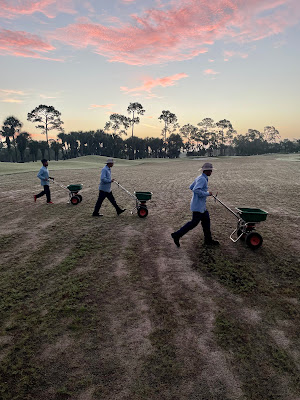
As the project progressed the "grow-in window" (time until opening) was obviously reduced. Therefore, we became more aggressive in our efforts to establish the sprigged areas. For approximately 21 days after planting, the sprigged areas are too soft for riding mechanized equipment. Therefore, we applied fertilizer by hand and used walk behind mowers to cut the turfgrass. 

Light frequent fertilization and mowing reduce top growth and encourages lateral growth (coverage) of the turfgrass.
Fertilization Hole 1 - September 11, 2021

All 55 acres sprigged received several cuts by hand prior to utilizing riding equipment. 
Tees
One aspect of the project that I have not reported on is the work performed on tees. After eradication, thatch removal and tilling, all of the tees were laser leveled to an exact 1% front to back slope and hand sprigged. 
Sod Removal 10 Tee

Laser Leveling - Hole 3

The clubhouse parking lot was used for the delivery and storage of the granite gravel, new bunker sand and the TifTuf sod. Once grassing began we had a standing order with Pike Creek Turf in Adel, GA for five semi-loads of sod six days a week. 

This week we completed the resurfacing and re-striping of the parking lot. All plant material was trimmed and new pinestraw installed so the area will look even better when you return than it did last year. 

All of the turfgrass at the clubhouse was also renovated this summer with Trinity Zoysia. 

Clubhouse Parking Lot


Collars
All of the TifGrand collars were replaced this summer. Although the collars were fairly recently renovated, it was necessary to "tie-in" the TifEagle greens into surrounding TifTuf areas. Particular care was placed on all areas where surface drainage leaves the putting surface.
Collar Preparation- Hole 3

Ancillary Projects

Countless ancillary projects, some small and others significant were completed throughout the project. These are items beyond what was reported in previous blog entries. Having managed the property for over 29 years, my team and I had a lengthy "to-do" list of items to accomplish during the renovation. There are literally hundreds that we completed so I will only highlight a few on each hole in this update. 

All of the subtle changes were discussed in advance with Greg Muirhead, Senior Vice President Rees Jones, Inc.

THE FRONT NINE

Hole 1
On the slope of the mounds to the left of the landing area, several trees were removed and the area was re-shaped to provide better playability on holes 1 and 10.
 
The subsurface in the high traffic area leaving the hole was amended to provide better turfgrass quality. 

To the left of the green soil was added to remove a "hinge point" and provide better turfgrass growth.
 
The underbrush between 1 green, 2 tee and 8 green was removed, which will provide better air movement and sunlight for improved growing conditions in all three areas.
 
Greens Complex
Mound Work Between 1&10

Hole 2
The tees were lowered, enlarged and the slope from the cart path to the tees was softened to make the walk from path to tee easier.
 
The first four mounds on the right side of the hole were softened to provide smoother and more access points to the hole from the path. This also accentuates the mounds in the landing area.
 
Trees were added between hole 2 & 8 that create more "eye-focus" from the tee to the landing area.

To the right of the green mounding was softened.
 
The subsurface behind the green was amended and soil added to enhance the chipping area and provide better turfgrass.
  
Trees were added behind the green (between 2&7) to providing better framing/depth perception. 

Underbrush was removed between 2 & 7 to provide better airflow and sunlight.

Hole 3
Numerous trees to the left of the tee complex were removed. My team planted them in 1993 to enhance the natural look of the lake bank. However, after close to 30 years the trees were blocking sunlight and airflow. 

A few palms and palmettos were added to the area to replicate the look of the bank on the opposite end of the lake (behind 2 tee).

A significant drainage project was installed and 3-4" of old bunker sand was added in the center of the hole to improve drainage.

Underbrush and dead trees were removed between 3 & 7 to provide better air movement and sunlight on 3 and 7.
 
2 1/2" of organic material in the swale left of the green was removed and soil added to reduce the severity of the slope from the path to the green. This will provide a more pleasant walk from the path to the green, as well as significantly improve surface and subsurface drainage. Both of these factors will improve turfgrass quality and playability.
June 1, 2021
Greens Complex Modification (View from Back)

Greens Complex - September 18, 2021

Hole 4
2-3" of old bunker sand was added in layers and worked into the fairway to improve drainage.

The underbrush and some of the trees in the "dog leg" on the right of the landing area were removed to improve visibility of the green. 

The fairway bunker was enlarged and "flashed" to improve visibility and enhance the left to right movement of the hole.   

The size (length) of the left green-side bunker was reduced.
 
Hole 5
The "III" tee was lowered and expanded 30%.

The last 10 yards of the "I / II" tee was removed. This area was rarely used and will reduce maintenance. The tee was also unlike any on the golf course. 

Several rows of trees to the west and north of the golf hole were removed to increase sunlight and airflow.

Hole 6
The mounding in front of the last fairway bunker on the left was lowered to increase the visibility of the bunker.
 
2-3" of the old bunker sand was added in layers and worked into the right side of the first landing area, and the left side of the second landing area. Amending the soil with sand here, and other areas on the golf course will improve drainage. 

A significant change was made to the right side of the green. 2 1/2" of organic material was removed throughout the swell and soil added to soften the slope and elevate the floor. This was done to creating a chipping area reminiscent of others on the golf course as well as increase access points to the green. 

The right side of the approach was lowered to increase visibility into the chipping area. 
 
Old Bunker Sand / Soil Modification 

Chipping Area (View from Back)

Hole 7
The tees were lowered 15-20" and enlarged 30%. 

A new "V" tee was added 16 yards in front of the now "IV" tee.

The left side of the approach was lowered 8-10" and the right side was raised by shifting the material, as well as adding additional soil. 

The right side of the approach was also softened. The end result is an approach that is "centered" with the green and more reminiscent to the others on the golf course. 
Approach - June 22, 2021

Hole 8
3-4" of the old bunker sand was added in layers and worked into the entire fairway to improve drainage.

Two semi-loads of Cabbage Palms were added on the right side of the second landing area to accentuate the right to left movement of the hole from the tee, as well as define the second landing area and create more eye-focus to the green.
  
A significant change was made to the two green-side bunkers. The floor of the bunkers were elevated 15-20". Both bunkers are now visible from the very beginning of the second landing area. The putting surface is also now visible when standing in either bunker.  
May 21, 2021

Hole 9
The mounds on the right of the tee complex were lowered 10-12" to enhance the view of the lake, as well as provides smoother and more access points to the hole from the path.

A significant change was made to the fairway bunkers. The floor of each bunker was elevate between 10" and 20". The framing on the two closest to the green was also lowered. This change will enable you to utilize a less lofted club and advance the ball closer to, or possibly onto the putting surface. 
 
The mounds on front right of the green were lowered 10-12" and the "saddle" where the majority of golf carts leave the hole was elevated. This was to help spread traffic as you leave the hole.
 
A drainage project was completed in the swale to the right of the green.

August 29, 2021

THE BACK NINE

Hole 10
The cart path on the left of the tee complex was moved closer to the tee and the slope softened to provide an easier walk from the path to the tee.

The left side of the second landing area received 2-3" of the old bunker sand to modify the soil. The slope of the fairway in this area was also adjusted to provide better surface drainage. 
 
The left of 10 green received significant soil modification and slope adjustment to enhance surface and subsurface drainage. 
 
Hole 11
The tees were lowered 10-15" and expanded by approximately 30%. 

A new "V" tee was added 26 yards in front of the now "IV" tee.
 
The last mound on the left side of the hole was lowered 8-10" reducing a traffic pinch point between the mound and the left green-side bunker. The area between the mound and the bunker was elevated with soil to provide better surface and subsurface drainage.
 
The slope on the back left of the greens complex was softened by adding soil. 

Dozens of trees behind the green were removed to regain turfgrass lost due to encroachment of vegetation. 
Tee Lowering and Expansion 
New "V" tee

Hole 12
Several rows of cabbage palms to the right of the mounds were removed to regain turfgrass lost to encroachment of vegetation. 

Hole 13
The tees were lowered 15-20" and the teeing surfaces expanded 30%.
 
The slope on the tees were significantly softened and the path moved closer. 
From the path you can now see the tee and pin locations allowing club selection without having to walk up the slope.  
The length of the bunker (from the tee) was reduced by approximately 20 yards.  

Mounding to the left of the hole was reshaped to regain/enhance the framing of the bunker, as well as regain turfgrass lost to encroachment of vegetation.
July 19, 2021

Hole 14
The tees were lowered 12-18" significantly softening the slope making the walk from the path to the tee shorter and easier.
 
The mounding to the right of the tee complex was lowered 12-18" to provide better access onto the golf hole, but more importantly opening up the view of the "lower/members fairway."

To the right of the green several trees were removed, soil added and the turfgrass line was shifted to move the path away from the framing of the bunker.
 
Behind the green soil was added reducing the severity of the slope making an easier walk from the path to the green. It will also improve turfgrass growth.
Tee Complex (mounds on right lowered) - July 19, 2021

Hole 15
The mounding between the middle and last fairway bunker was lowered to increase the visibility of the bunker.
  
2 1/2" of organic material was removed from the front left chipping area and soil was added to elevate the area and increase shot options. This made the chipping area more reminiscent of others on the golf course.
Front Left Chipping Area (View from Green)

Hole 16
A large majority of the old sand removed from the back 9 bunkers was utilized on hole 16. After the turfgrass was removed from the center of the hole, approximately 4" of sand was added. The sand was added in layers and worked into subsurface between each application.
 
2 1/2" of organic material was removed from the chipping areas behind the green and the soil was modified and elevated to increase the shot options. This made the chipping area more reminiscent of others on the golf course.
Back Left Chipping Area 
Back Right Chipping Area 

Old Bunker Sand 

Fairway Soil Modification (Old Bunker Sand)

Hole 17
The tees were lowered 15-18" to increase the teeing area. The slope was also significantly softened and the path moved closer. 
From the path you can now see the tee and pin location allowing club selection without having to walk up the slope.
The path was shifted the entire length of the hole increasing the visibility of the hole and reducing the time to drive to the green.

A small ridge in the center of the approach was removed and soil added to center and elevate the approach.
 
Hole 18
The left fairway bunker was shifted to the right several feet leveling the floor of the bunker. The framing on the front of the bunker was also lowered. This change will enable you to utilize a less lofted club and advance the ball closer to, or possibly onto the putting surface. 

The left of 18 green received significant work. 2 1/2" of organic material from the green to the path was removed. Also including in this process was the area behind 1 and 10 tee. 4-6" of old bunker sand was added to the area and tilled to increase surface drainage. 
  
The mounds to the left of the green were softened and several trees removed between 10 and 18. This   
expands the turfgrass in the area leaving the green and enhances the view of the clubhouse. 
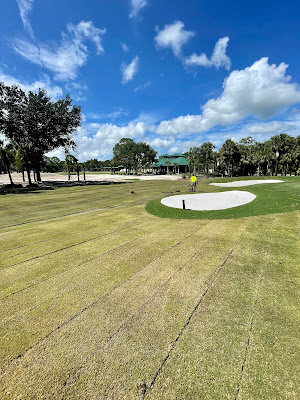
August 21, 2021

October 7, 2021

Greens
With everything happening with the renovation, we still performed all of the necessary cultural practices to insure our 29-year old USGA greens continue to perform at the high level that we have provided in the past. 

We began the summer with a "double" Drill and Fill and ended with a DryJect "Maximus" sand injection. In between, my staff also performed four traditional core aerations.     

Drill & Fill - April 26, 2021

DryJect “Maximus” - September 27, 2021

August 31, 2021

August 31, 2021

Thank you for taking the time to read this update! 

My team and I are eager to have you back at Olde Florida and enjoying the special place that we have, and that was improved upon this summer!