Monday, September 16, 2024

Tif3D ... Dark, Dense and Durable

In early 2024, after nearly a decade of research trials, University of Georgia Turfgrass Breeder, Brian Schwartz has released a cutting edge bermudagrass variety named Tif3D. I am confident that Tif3D will become the standard on warm season putting greens. That is a bold statement, but it’s one that I strongly believe!


Olde Florida was one of 23 test sites for Tif3D. On September 18, 2019, when it was planted on our research green, the grass had the experimental name 12-TG-101. Before I provide rationale on why feel Tif3D will become the standard for warm season putting greens, let me provide a brief history of turfgrass varietal testing at Olde Florida.


Darren J. Davis, Olde Florida Golf Club and Dr. Brian Schwartz, University of Georgia 


A couple years after we opened Olde Florida in 1993, there was a buzz in the golf course industry about the new “ultradwarf” varieties that were being evaluated in research trials in the Southeast. When we originally grassed Olde Florida, TifDwarf, which was released in 1965, was the standard for warm season putting greens.


In 1995, I was asked by Dr. Wayne Hanna, then a turfgrass breeder with the United States Department of Agriculture, if I would include his latest experimental turfgrass, TW-72 in trials we were establishing. TW-72 had already been in testing for several years, and it was considered an “ultradwarf.” Aware of the renowned history of the Tifton, Georgia, breeding program I quickly agreed. After a decade of testing, on December 21, 1999, what was TW-72 received a patent under the name TifEagle.


After successfully managing TW-72/TifEagle for over five years in our trials, in the summer of 2000, Olde Florida underwent a renovation that included replacing the TifDwarf on our greens with the recent release of TifEagle. It’s the opinion of most in the industry that TiFEagle quickly became and remains the standard for warm season putting greens.


Now, back to what I believe will replace TifEagle as the new standard for warm season putting greens—Tif3D. As I said, in September of 2019, we planted what was formerly 12-TG-101 (now Tif3D) on half of a 1,000 square foot green. Adjacent to the 12-TG-101, we planted TifEagle. The 12-TG-101 and TifEagle sprigs were harvested on the day prior to planting at Pike Creek Turf in Adel, Georgia, and they were planted at equal rates on our research green. Both varieties are managed identically, and after grow-in, have been maintained the same as the TifEagle greens on our golf course.


What we have seen over the past five years is that Tif3D has numerous attributes that enable it to excel over TifEagle. The tag line being used by the University of Georgia and the growers of Tif3D is “Dark, Dense and Durable.” Without a doubt that is accurate! We have seen the attributes used in the tag line at Olde Florida. I will expand on the three adjectives.


NOTE: When some of the photos below were taken the name Tif3D had not been chosen. Therefore, Tif3D in some photos is labeled “101”, a shortened version of its experimental name.


Dark

Color doesn’t affect playability, but Tif3D has a dark green color. Several things including fertility have an impact on color, but since both sides of the test green are managed identically, that is not a factor. At times, the color difference is marginal, but at others it has been 

dramatic.


Tif3D (left) is consistently darker than TifEagle (right)


Tif3D (left) is consistently darker than TifEagle (right)


Dense

Tif3D has a narrower leaf blade compared to TifEagle. One of the advantages of a narrower leaf blade is increased green speed. Dr. Schwartz and his team visited the test site numerous times a year since 2019 and, among other things, they measured green speed. Consistently, the speed of the Tif3D was greater than that of the TifEagle.


Tif3D has a finer texture than TifEagle

Tif3D has a finer texture than TifEagle


Often a negative of a fine-textured turfgrass is it can get “puffy” and present increased thatch accumulation. That is not the case with Tif3D. In fact, we have seen the opposite. On numerous occasions, we have witnessed the mower “grabbing” on the TifEagle side of the green and not on the Tif3D side.


TifEagle (right) can become "puffier" than Tif3D (left) causing mower "grabbing/scalping"

Durable

Tif3D is certainly “durable”! Durability is defined as, “The ability to withstand wear, pressure or damage.” Tif3D is all that and more. Another aspect of its “durability” is the ability to recover quickly.


Although durable, like all turfgrass, Tif3D will undergo stress in extreme conditions, but we have seen in the side-by-side trial that Tif3D has better stress tolerance than TifEagle. Secondly, we have seen that when Tif3D does go under stress, its recoverability is much better than TifEagle’s.


Tif3D (left) has a higher stress tolerance than TifEagle (right) 


16 days after moisture stress (above) the Tif3D (left) has recovered quicker than the TifEagle (right)

We have also seen quicker recovery on Tif3D as compared to TifEagle from multiple stressors including ball marks, aerification and vertical mowing.


Tif3D (right) recovers from aerification quicker than TifEagle (left) 

Tif3D has also shown durability when under pressure from Fairy Ring.


Tif3D (left) has a higher tolerance/recovery from Fairy Ring than TifEagle (right) 


Other Applications of Tif3D / Tif3D “Grown on Plastic”


In addition to the 2019 Tif3D/TifEagle research green, we have another 1,000 square foot research green in our test area that was constructed at the same time with identical specifications.


Surrounding the two greens is an additional 6,000 square feet, which has been used to grow various turfgrass varieties through the years. After lengthy discussions with Dr. Schwartz in 2022 and 2023, we made the decision to eradicate what was on the second green, as well as the 6,000 square feet surrounding the two greens. During the summer of 2023, we embarked on a thorough eradication that eliminated all the turfgrass in the test area, with the exception of the Tif3D/TifEagle green planted in 2019.


On September 21, 2023, the green, as well as the entire area surrounding the 2019 research green, was planted with Tif3D “Grown on Plastic” (GOP). Tif3D GOP provides a new option for golf courses compared to traditional sprigging. Tif3D GOP only requires weeks of grow-in time to be a puttable surface instead of the standard months. 


Since the product is grown on plastic, it’s not damaged when harvested, transported and installed. The roots remain intact and are not cut during harvest, reducing stress and transport shock, which results in a higher quality product and faster establishment.


The Tif3D GOP research green has been exceptional. We are managing it identically to the 2019 Tif3D/TifEagle green.


The surrounding 6,000 square feet of Tif3D is being maintained at two heights of cut. Both greens have a 48” collar that is currently being mowed at .200. The Tif3D collars are treated the same as the TifGrand collars we manage on the golf course.


The remainder of the 6,000 square feet is being managed in the manner of an approach or “chipping area.” The current height of cut is .400.


The Future


In 2019, in the planning stages of our 2021 golf course renovation, I was asked by the Olde Florida Board of Directors, “If we decide to renovate our greens, is there a turfgrass variety better than our existing TifEagle?”


Although our TifEagle at the time was 19-years old, my answer to the question was, “No.”  This was one factor in our decision to not renovate our greens.  If I were to be asked the same question today, my answer would be unequivocally, “Yes, there is, and that grass is Tif3D.”


For information published by the University of Georgia on Tif3D click HERE.


Monday, August 5, 2024

Tropical Storm Debby ... and all things Olde Florida

All golf course superintendents know that managing turfgrass, a living, breathing organism subjected to numerous environmental stresses year round, can bring new challenges everyday.” This summer the rain has certainly been our biggest challenge at Olde Florida!

The center of Tropical Storm Debby was a 100 miles off our coastline yesterday morning. Her fast moving, but rainfall laden outer bands dumped 8.5” of rain on Olde Florida over the weekend. That brings the total rainfall in the last 65 days to 47.4”!  In addition to the 8.5” Debby deposited on Olde Florida, in June we received 24.25” and 14.65” in July. These are a few pictures taken at Olde Florida this morning. 


On a positive note, the evapotranspiration rates and the available hours of sunlight are both very high in the summer months and our turfgrass is very healthy!  Once the water recedes, recovery of the minimal damage will be extremely quick.

We have also been fortunate the rain this summer has primarily occurred on days we are not scheduled for a summer closure. While this is unfortunate for the members that play Olde Florida in the summer, it’s fortunate for the membership at large because we are on schedule with our necessary cultural practices and projects.

Since my last entry, It's Summer in Southwest Florida ... and that means it's "Cultural Practice Season!" , the greens have received another 5/8” core aeration and a second Drill and Fill process. 


The tees and approaches have been aerified and we have installed another 250’ of drainage on #11 approach and 175’ to the right of 8 green. 


We have also made our annual application of Chipco Choice for mole cricket control (video below) and our tree project on #17 is progressing.


Our hard work to provide the best possible playing conditions for the members and guests of Olde Florida will continue! Hopefully mother nature continues to reasonably cooperate!

Tuesday, June 18, 2024

Summer Update #1

It's summer in Southwest Florida and that means it's "cultural practice season" for area golf courses. Before detailing what we have, and will be doing at Olde Florida this summer, I think it's important to reflect on the past winter. 


The strong El Niño weather pattern we experienced last winter created the most challenging period to grow turfgrass I've experienced in my 35 years in South Florida. Essentially it was the “perfect storm”! In December, January and early February our golf play was at its peak, which creates physical stress and wear on turfgrass. This is also the time when our days are the shortest, the angle of the sun is at its lowest and we had the cloudiest period in over 83 years. If that were not enough, we experienced below average temperatures and above average rainfall. All of these things individually slow the growth of warm season turfgrass and cause decline. Undoubtedly, if my team had not completed essential cultural practices over the last 30 years, we would NOT have fared as well as we did. 


Click HERE for more information on last winters strong El Niño weather pattern and the challenges it created. 


The work we will perform this summer will be similar to most years. However, after last winters challenges we are going to be a little more aggressive in our cultural practices as well as complete a few special projects.


Every summer we schedule extended closures so my staff can perform the vital tasks of aerification, vertical mowing and topdressing. These are essential to insure the turfgrass remains as healthy as possible and the golf course is in the best possible condition for years to come. 


These tasks are performed in the summer when our play is the slowest, but equally important it’s the time of year when our warm season bermudagrasss is growing at it’s peak. As explained above, ironically, when our play is at its peak, the turfgrass is growing the least. 


In basic terms, for turfgrass to thrive it needs sunlight, water, nutrients and air. All are critical, but the one we try to influence the most in the summer is air (in the soil). A well drained rootzone is critical for turfgrass. Aerification, vertical mowing and topdressing all help to dilute the natural occurring organic matter beneath the surface. This helps to increasing air in the soil, water infiltration rate and ultimately turfgrass rooting.


The picture below was taken in mid-May. It is a 6” below ground slice of 16 green. The red arrow is pointing to a single root that is growing from the plant on the surface through a sand channel. A root growing to this depth, on a green being cut at 1/10th of an inch, demonstrates the value of aerification and sand in promoting a well drained, oxygenated soil.


Root in Sand Channel, 16 Green, May 2024

This summer we will complete a similar quantity and aggressiveness of our cultural practices on all areas of the golf course, as well as increase the aerification and topdressing on our 32-year old greens. 


In addition to traditional core aeration on the greens, we will again hire a contractor to perform two separate “Drill and Fill” processes. The Drill and Fill machines have a series of 1” bits that drill to a depth of 10” and then fill the channel with bagged, dried sand. A total of 126 tons or 252,000 pounds of sand was used on the first process completed May 28 - May 31. 


Drill and Fill, Practice Green, May 28, 2024 


Conventional Core Aeration, Practice Green, May 29, 2024  

We will also once again topdress the fairways with 1/4” of coarse sand. This was completed during our first closed week. A total of 879 tons or 1,758,000 pounds of sand was used. We will topdress our wetter fairways multiple times throughout the summer. The additional sand topdressing we performed last year on fairways 2 and 8 raised the surface over 1”. 


Topdressing 6 Fairway, May 28, 2024


As we do every summer, we will complete over 1,000 feet of subsurface drainage. We have already installed 200’ on #12 approach.   


Drainage Project on Hole 12, June 10, 2024

Drainage Project on Hole 12, June 10, 2024

Other projects include removing a few trees to the left (south side) of hole 17. Since opening the golf course 31 years ago the elevated canopy of the pine tress has significantly decreased sunlight on 17 green. We will also remove some undergrowth in this area which will increase surface airflow.


In summary, when you manage a living, breathing organism subjected to numerous environmental stresses year round, every day can bring new challenges. My staff and I work all 365 days each year to give the 112 acres of turfgrass we manage the best opportunity to thrive.  


Tuesday, May 21, 2024

The Great Crested Flycatcher

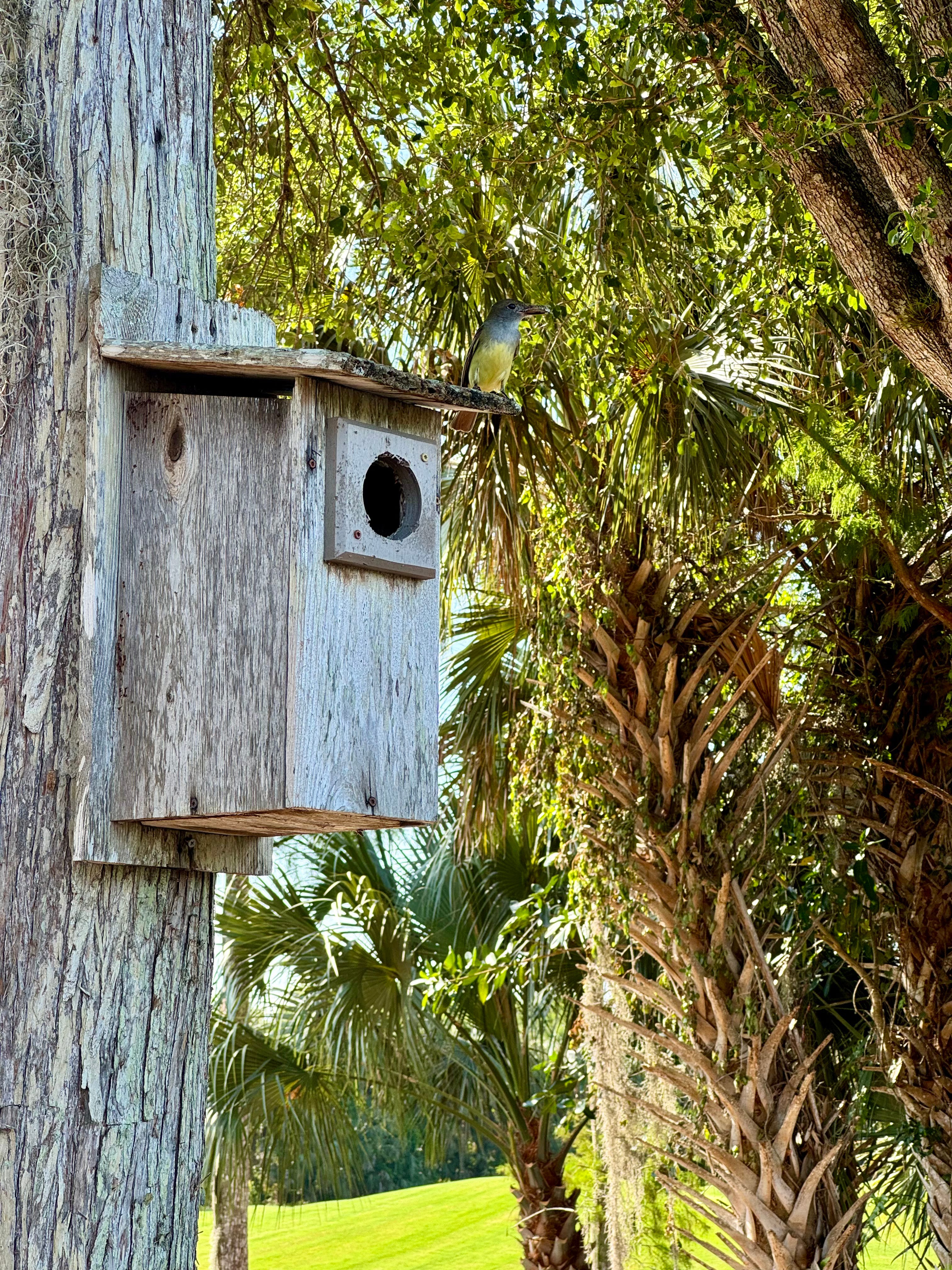
Olde Florida has numerous Eastern Screech Owl boxes that are used every year by returning mothers. After the Screech Owls have utilized the nest for their current clutch, other birds sometimes “make themself at home.” This year a Great Crested Flycatcher once again moved into one of the boxes. 


The Flycatcher is easily identifiable by its unique nest construction and eggs. A very interesting aspect of the nest is it almost always includes a piece of snake skin lining. The snake skin is brought into the nest by the flycatcher as a natural predatory defense mechanism.


Great Crested Flycatcher Nest on Hole 17, Olde Florida Golf Club, 4/30/24


Both sexes help build the nest. They carry in large amounts of material, to bring the nest level closer to the entrance. The flycatcher nest is made of grass, weeds, strips of bark, feathers, or other debris, lined with finer materials such as pine needles.


The Great Crested Flycatcher usually lays five eggs that are creamy white and marked with brown, olive, lavender. Incubation is by female (13-15 days), but both parents bring food for nestlings. 


Adult Great Crested Fly Catcher Bringing Food, Hole 17, 5/16/24 


Great Crested Flycatchers are large flycatchers with fairly long and lean proportions. Like many flycatchers they have a powerful build with broad shoulders and a large head. Despite its name, this bird’s crest is not especially prominent. 


The age of the young at first flight is about 12-18 days. The male defends nesting territory with loud calls, sometimes by fighting with other males. Nest sites are usually in the hole of a tree, either natural cavity or old woodpecker hole, but the flycatcher will also nest in artificial sites. 


Three of Five Hatchlings on Hole 17, 5/13/24


The species is known to forage by flying out from a perch to catch insects. They often hover momentarily while taking insects from foliage or twigs, or may catch them in mid-air.  The Flycatcher feeds on a wide variety of insects, including caterpillars, moths, butterflies, katydids, tree crickets, beetles, true bugs, and others. They also eat spiders, sometimes small lizards, and regularly eats fruits and berries. Small fruits may be a major part of diet in winter in the tropics.


To see and hear a Great Crested Flycatcher you can click this Link.

Thursday, April 4, 2024

Annual Report To The Olde Florida Golf Club Membership

Annual Report To The Olde Florida Golf Club Membership

April 2024


Prepared by:

Darren J. Davis, CGCS

Golf Course Superintendent

darrenjdavis@oldefloridagolfclub.com

(239) 353-4441 - Office

www.DarrenJDavisGCS.com


Golf Course Update

After four back-to-back winters in a La Niña weather pattern, with numerous heat records and ample sunlight, this year we experienced our first El Niño weather pattern since 2018-2019. This winter turned out to be an extremely strong El Niño weather pattern, resulting in the most difficult winter to manage turfgrass in my 31-years at Olde Florida.

El Niño is a climate interaction linked to warming sea temperatures in the central and east-central Pacific Ocean. The warmer waters cause the jet stream to move south of its typical position. During an El Niño winter, the southern 1/3 to 1/2 of the United States experiences cooler than normal temperatures, increased cloud cover and enhanced precipitation. 

The challenge with above average precipitation in the winter months is; with low evapotranspiration rates the soil remains saturated, decreasing oxygen and limiting root growth. Combined with the extreme cloud cover (the cloudiest December and January in over 83 years) growing grass was very challenging.

My staff and I worked diligently and did things never needed in all of our previous seasons. Among other things, disease pressure required increased fungicide applications on greens, tees and even fairways. As a point of reference, we are currently 40% over the annual fungicide budget, with 6-months remaining in the fiscal year.  Other adjustments made to combat the weather challenges included increased solid-tine aeration, higher heights of cut and reduced mowing.

For more in depth information on El Niño and the challenges it presented, please visit these four links (written this season) on my blog:

All I Want For Christmas... Is Sunshine 

El Niño And Its Effect On Turfgrass Management 

How Does Turfgrass Eat? (El Niño Part 2)

El Niño's Effect In Florida: Explaining It To Golfers, Boards and Owners

When sunlight finally returned to normal levels in February our hard work this winter was rewarded and we have finished the 2023/2024 winter golf season extremely strong!

Purity of the TifTuf turfgrass, planted as part of the 2021 renovation remains very high. The goal was 99% eradication of the existing grass during the 2021 renovation, and we achieved that. As of the 2023/2024 season, we are still at approximately 97-98% purity. This level will drop slowly each year.   

This summer we will continue similar work that has been performed in previous years. This includes cultural practices such as aerification, vertical mowing and topdressing. Last year we expanded our topdressing of tees and greens to include fairways. All of the fairways received 1/4” of sand. The fairways on holes 2 & 8 (our wettest fairways) received an additional three 1/4” topdressing applications for a total of 1” of sand. It is a significant investment, but it results in firmer, better draining fairways.

For an explanation on why we perform these practices please visit my July 2023 blog entry: "Why Do You Aerify Greens When They Are In Great Condition?"

The cultural practices we perform annually in the summer months greatly assist in winter conditioning. They are also crucial to survive challenging weather patterns.

Drainage, tree trimming and underbrush maintenance are also routine summer projects.  Last summer my staff installed 1,700 linear feet (1/3 of a mile) of subsurface drainage. That brought the total subsurface drainage that my teams have installed in the last 30 years to over 16 miles.

For more on the drainage work we perform please visit my August 2023 blog entry: Drainage...Drainage...Drainage!!!

Golf Cart Usage

I would like to thank the majority of the membership who are driving golf carts responsibly and according to club policy. As a reminder, we ask that all members and guests keep golf carts off turfgrass around tees (exiting the path after the last green and white post) and keep carts outside the green and white posts around putting greens. Your adherence to this policy will benefit your fellow member and provide the highest quality turfgrass for everyone to enjoy.

Vanderbilt Beach Road Extension Update

The Vanderbilt Beach Road Extension project is a 7-mile extension of the existing six lane.  The extension will begin to the west at Collier Boulevard and it will end at 16th St. The county estimated the project will take approximately three years to complete. The project began in the fall of 2022.

Subsurface work on the road work and the new canal excavation continued this season. This has created a few challenges with dust. I am pleased that the contractor hired for the project by Collier County, Sacyr Construction has been extremely responsive when I have reached out for assistance and updates.

In the near future all existing connections (outfall and intake pipes) into the old canal will be extended to the new canal. When completed the existing canal will be filled in. Next season (2024/2025) paving at our end will occur and if they stay on schedule, the project should be complete in the fall of 2025. Unfortunately the 8’ chain link fence and planting on our southern property line will not be complete until the end of the project.

For more information on the Vanderbilt Beach Road Extension project you can click Here.

Additional Information/Year-Round Updates

Please feel free to reach out at anytime if I can assist with anything, and if you are not already doing so, please follow the Olde Florida Facebook page and subscribe to my blog for more frequent updates on the golf course. Links to these can be found on my website: www.DarrenJDavisGCS.com

Monday, March 18, 2024

El Niño’s Effect in Florida: Explaining it to Golfers, Boards and Owners

Recently I was asked by the Golf Course Superintendents Association of America (GCSAA) to co-present a webinar that addressed impacts the strong El Niño pattern was having on golf courses. The title of the webinar is, “El Niño’s Effect in Florida: Explaining it to Golfers, Boards and Owners.” A link to an abridged copy of the webinar can be found HERE. 


I was joined by J. Bryan Unruh, Ph.D., University of Florida. Dr. Unruh is an Associate Center Director and Professor of Turfgrass Science. Unruh focuses on providing real-world solutions for today’s turfgrass manager. His work centers on water quality (nutrient leaching and runoff) and quantity (drought) concerns, pest management, and new turfgrass cultivar development.


Over 200 GCSAA members registered for the webinar. After completion, a link to the webinar was posted on the GCSAA website so it could be shared with golfers, facility board of directors and owners to explain how golf course superintendents deal with weather, and weather extremes such as strong El Niño and La Niño patterns.


December and January were the cloudiest in South Florida in 83 years


Wednesday, February 7, 2024

How Does Turfgrass Eat?

When humans are hungry we eat. If we didn’t, we wouldn’t survive. 

Have you ever thought about how turfgrass gets food? In the form of a formula it looks like this: 6CO2 + 6H2O + Light energy → C6H12O6 (sugar) + 6O2.  You might have learned this in high school botany class. This is the formula for photosynthesis.

All plants (including turfgrass) are called “autotrophs” because they use energy from light to make their own food source. Many people believe plants are provided food when nutrients are applied in the form of fertilizer. While a balanced soil and nutrient applications are necessary, the reality is plants use sunlight, water, and the gases in the air to make glucose, which is a form of sugar that plants need to survive. This process is called photosynthesis and it is performed by all plants.

There are many steps in photosynthesis, but the last requirement is an important one because it provides the energy to make sugar. The final step is the Sun!

The energy from light causes a chemical reaction that breaks down the molecules of carbon dioxide and water and reorganizes them to make sugar (glucose). After the sugar is produced, it is then broken down into energy that can be used by turfgrass for growth and repair. 

The bottom line is without sun a plant can’t create food and regardless of what inputs we as turfgrass managers provide, or the management we perform, without sun turfgrass doesn’t survive.

Recently I wrote a post El Niño and it's Effect on Turfgrass Management  In the post I provided data that showed December was the cloudiest December in South Florida since 1940. Recently the same data was released for January. The data (below) shows that January was also the cloudiest since 1941. This makes the back to back months the cloudiest in 83 years!


While it has been a challenge, due to various management strategies we have maintained turfgrass cover on all playing surfaces. Without a doubt, it hasn't been an easy task! 

With the Winter Solstice behind us, (Link to blog entry on Winter Solstice) we'll have the opportunity for another minute a day of sunlight, and with the winter we've had, we will take every minute we can!


#1 Green - Wednesday, February 7, 2024